
Acceptance Quality Limit (AQL) sampling is a statistical method for deciding whether to accept or reject a lot of product by inspecting a sample instead of every unit. It gives quality teams a defensible lot decision when 100% inspection is too slow, too expensive, destructive, or less reliable than people assume.
AQL sampling is formalized in standards such as ANSI/ASQ Z1.4 and ISO 2859-1, both rooted in the acceptance-sampling structure that evolved from MIL-STD-105E. The tables connect lot size, inspection level, sample size, AQL, and acceptance/rejection numbers.
The key discipline is understanding what the method can and cannot promise. AQL is a long-run sampling-plan parameter, not a zero-defect guarantee for an individual shipment.
Why AQL Sampling Matters
AQL sampling exists because 100% inspection is neither free nor perfect. Inspecting every unit consumes time, disrupts flow, can destroy tested product, and still depends on human attention. A well-designed sampling plan gives the organization a standard, auditable way to make lot acceptance decisions with quantified risk.
Statistically Defined Risk
Every plan carries a known probability of rejecting a good lot or accepting a bad one.
Inspection Efficiency
Sampling cuts inspection burden while preserving a defined decision rule.
Supplier Alignment
ANSI/ASQ Z1.4 or ISO 2859-1 gives suppliers and customers common language.
Built-In Escalation
Normal, tightened, and reduced inspection respond to recent lot history.
Core Terms
| Term | Meaning |
|---|---|
| Lot or batch | A defined quantity of product, produced under reasonably uniform conditions, submitted for inspection as one unit. |
| AQL | The maximum percent defective or defects per hundred units that can be considered satisfactory as a process average for sampling purposes. |
| LTPD | Lot tolerance percent defective, a worse quality level the plan is designed to reject with high probability. |
| Sample size | The number of units drawn from the lot and inspected. |
| Acceptance number (Ac) | The maximum number of defects or defectives allowed while still accepting the lot. |
| Rejection number (Re) | The minimum number of defects or defectives that rejects the lot, typically Ac + 1. |
| Producer's risk | The probability that a genuinely good lot will be rejected by chance. |
| Consumer's risk | The probability that a genuinely bad lot will be accepted by chance. |
How AQL Sampling Works
AQL implementation starts by choosing an inspection level, an inspection state, and a sampling structure. These choices define how much inspection effort the organization applies and how strongly the plan discriminates between good and poor quality.
| Inspection level | Sample size | Typical use |
|---|---|---|
| Level I | Smaller | Lower-risk items or established suppliers with strong performance. |
| Level II | Standard | Default level for most routine inspection situations. |
| Level III | Larger | Higher-risk items, new suppliers, unproven processes, or stronger discrimination needs. |
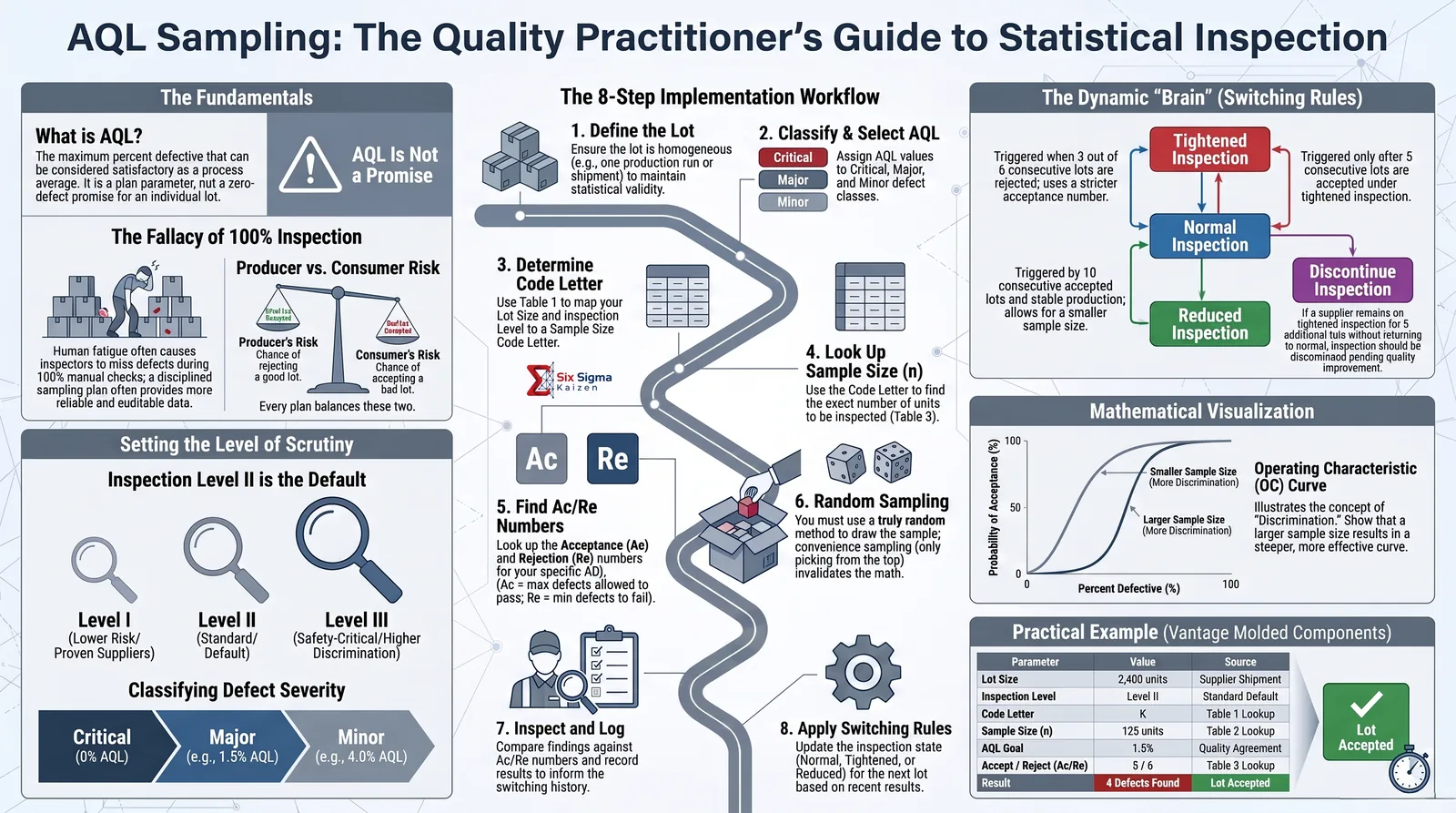
Sampling programs also move between normal, tightened, and reduced inspection. Normal is the starting point. Tightened inspection is triggered by poor recent lot history, often when two of the last five lots have been rejected. Reduced inspection can be used after sustained good performance, often after ten consecutive accepted lots under the standard's conditions.
Reading the AQL Tables
In practice, AQL sampling usually requires three table lookups: find the sample size code letter from lot size and inspection level, convert the code letter to a sample size, then find the acceptance and rejection numbers for the chosen AQL.
| Lot size range | Level I | Level II | Level III |
|---|---|---|---|
| 2-8 | A | A | B |
| 9-15 | A | B | C |
| 16-25 | B | C | D |
| 26-50 | B | D | E |
| 51-90 | B | E | F |
| 91-150 | B | F | G |
| 151-280 | B | G | H |
| 281-500 | B | H | J |
| 501-1,200 | C | J | K |
| 1,201-3,200 | C | K | L |
| 3,201-10,000 | C | L | M |
| Code | Sample size | Code | Sample size |
|---|---|---|---|
| A | 2 | J | 80 |
| B | 3 | K | 125 |
| C | 5 | L | 200 |
| D | 8 | M | 315 |
| E | 13 | N | 500 |
| F | 20 | P | 800 |
| G | 32 | Q | 1,250 |
| H | 50 | R | 2,000 |
Use the current, complete ANSI/ASQ Z1.4 or ISO 2859-1 tables for contractual or regulated work. The summary tables here are instructional and do not replace the standard's master tables, arrow-adjustment rules, or special inspection levels.
Worked Example
Vantage Molded Components receives a lot of 2,400 injection-molded housings from a supplier. The quality team uses Inspection Level II and an AQL of 1.5% for major defects.
- Lot size 2,400 falls in the 1,201-3,200 range.
- At Inspection Level II, the sample size code letter is K.
- Code letter K gives a sample size of 125 units.
- At AQL 1.5%, the illustrative normal-inspection plan gives Ac = 5 and Re = 6.
- The inspector randomly samples 125 units and inspects against the defined major-defect criteria.
If the inspector finds five or fewer defective housings, the lot is accepted. If six or more are found, the lot is rejected. In the example, four defective housings are found, so the lot is accepted and the outcome is logged into the supplier's switching-rule history.

OC Curves and Risk
Every sampling plan has an operating characteristic (OC) curve: the probability of accepting a lot plotted against the lot's true percent defective. The curve shows what the sampling plan actually does, which is why it matters more than the table lookup alone.
- Near 0% defective, the probability of acceptance approaches 1.0.
- At the AQL, acceptance probability is high but not perfect, so producer's risk remains.
- At the LTPD, acceptance probability is low but not zero, so consumer's risk remains.
- Steeper curves discriminate better between good and poor lots.
Setup Steps
- Define the lot. Keep lots homogeneous by production run, shipment, line, or time period.
- Classify defect severity. Separate critical, major, and minor defects instead of treating all defects equally.
- Select the inspection level. Use Level II by default, Level III for higher risk, and Level I only when lower scrutiny is deliberate.
- Choose AQL values. Set AQL by severity class and document the decision in the supplier quality agreement.
- Look up n, Ac, and Re. Use current standard tables for the lot size, inspection level, AQL, and inspection state.
- Draw a random sample. Avoid convenience sampling from the top of a pallet or the easiest box to reach.
- Inspect and record. Record defects by severity class and keep the inspection state visible.
- Apply switching rules. Move future lots between normal, tightened, and reduced inspection based on history.

Where AQL Fits
| Application | How AQL Helps |
|---|---|
| Incoming inspection | Creates a consistent accept/reject rule before supplier material enters production. |
| In-process inspection | Checks batches before defects compound through downstream operations. |
| Final inspection | Provides a statistically grounded checkpoint before shipment. |
| Supplier quality | Turns lot results into supplier scorecard data and corrective-action triggers. |
| Contracts and audits | Gives both parties a documented standard for quality disputes and reviews. |
AQL vs. Other Approaches
| Approach | Best for | Limitations |
|---|---|---|
| AQL sampling | Routine lot acceptance where quantified sampling risk is acceptable. | Does not guarantee individual lots are defect-free. |
| 100% inspection | Safety-critical or low-volume high-value items where any escape is unacceptable. | Slow, costly, and still vulnerable to human detection limits. |
| SPC | Monitoring stable processes to catch drift before defective product is made. | Requires process stability and does not make a lot-by-lot accept/reject decision by itself. |
| Skip-lot inspection | Very high-confidence suppliers with strong history. | Raises risk if supplier quality degrades between inspected lots. |
The strongest quality systems layer these methods. SPC detects process drift, AQL sampling protects lot acceptance decisions, supplier audits evaluate systems, and corrective action closes the loop when the data show repeated risk.
Common Mistakes
Non-Random Samples
Convenience selection invalidates the statistical assurance the plan depends on.
Skipped Switching Rules
Ignoring tightened and reduced inspection removes the plan's built-in response to history.
One AQL for All Defects
Critical, major, and minor defects need severity-based treatment.
No Corrective Action Trigger
Tightened inspection should feed supplier development, not just more inspection records.
Quick Reference
Setup Checklist
- Lot definition is clear and consistent.
- Defect severity classes are documented.
- Inspection level is selected based on risk.
- AQL values are documented in the supplier agreement.
- Current ANSI/ASQ Z1.4 or ISO 2859-1 tables are available.
Execution Checklist
- Sample size code, n, Ac, and Re are looked up correctly.
- Sample is genuinely random.
- Defects are recorded by severity class.
- Lot decision and inspection state are logged.
- Switching rules are applied lot over lot.
Related Pages
Use this guide with the broader Quality Engineering Hub, the Sampling Methods body-of-knowledge entry, and the Sample Size and Confidence Calculator when planning inspection studies. For systems context, connect AQL decisions to Quality Standards and Frameworks, Control Charts, and Supplier Quality Management. The companion AQL sampling video is also listed in the video library.
Sources and Further Reading
- ANSI/ASQ Z1.4: Sampling Procedures and Tables for Inspection by Attributes.
- ISO 2859-1: Sampling Procedures for Inspection by Attributes.
- Douglas C. Montgomery, Introduction to Statistical Quality Control.
- Acheson J. Duncan, Quality Control and Industrial Statistics.
- ASQ Certified Quality Engineer Body of Knowledge.