
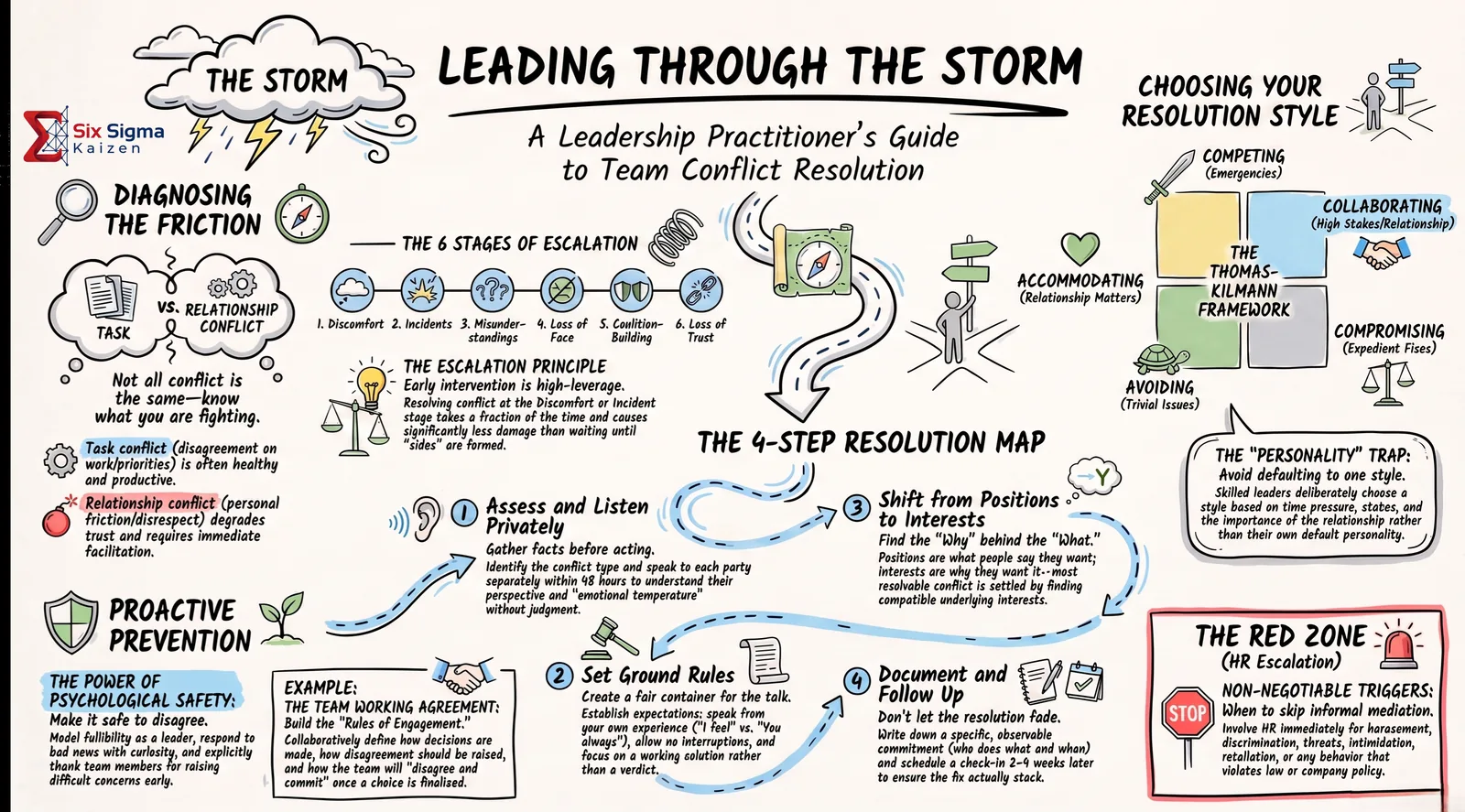
Recognizing, facilitating, and resolving conflict so teams come out stronger. This guide treats conflict resolution as a leadership discipline: understanding the anatomy of conflict, choosing the right resolution style, running a fair process, using productive language, and building norms that prevent avoidable conflict from accumulating.
Why Conflict Resolution Is a Core Leadership Skill
Every team that does meaningful work will experience conflict. Two engineers disagree about an architecture decision. A sales lead and an operations manager clash over which customer commitments are realistic. A quiet team member feels steamrolled in every planning meeting by a more vocal colleague. None of this means the team is broken — it means the team is made of people with different priorities, working styles, and stakes in the outcome. Conflict is not the failure. What a leader does next is what determines whether that conflict becomes fuel for a better decision or the beginning of a slow unraveling.
Leaders who avoid conflict, suppress it, or handle it poorly do not eliminate it — they just push it underground, where it resurfaces as disengagement, passive resistance, gossip, turnover, and eventually a team that has stopped bringing its best thinking to the table. Leaders who handle conflict well build something rarer: a team that trusts disagreement enough to have it openly, resolve it constructively, and move forward with more commitment than they had before the conflict surfaced.
This guide treats conflict resolution the way a skilled leader should — not as a single dramatic conversation, but as a discipline: recognizing conflict early, understanding what is actually driving it, choosing the right approach for the situation, facilitating a fair process, and building the team norms that prevent unnecessary conflict from accumulating in the first place.
What Conflict Resolution Brings to a Team
- Better Decisions: Teams that surface disagreement before a decision is made catch blind spots that harmony-seeking teams miss entirely. Unresolved conflict hides information; resolved conflict reveals it.
- Psychological Safety: When people see conflict handled fairly — not punished, not ignored, not won by whoever is loudest — they become more willing to raise concerns early, before small problems become expensive ones.
- Retention: Chronic unresolved conflict is one of the top drivers of voluntary turnover, particularly among high performers who have other options and little patience for dysfunction they did not create.
- Trust in Leadership: How a leader handles the first serious conflict on a new team sets the template for how every future conflict will be handled — and whether people believe the leader is fair.
- Stronger Relationships: Paradoxically, teams that work through real conflict together often develop deeper trust than teams that have never had a serious disagreement, because they now know the relationship can survive friction.
Section 1: Understanding Team Conflict
Before a leader can resolve conflict well, they need to understand what kind of conflict they are actually looking at. Not all conflict is the same, it does not all come from the same source, and it does not all require the same response. Misdiagnosing the conflict is one of the most common reasons well-intentioned interventions fail.
Step 1: Identify the Type of Conflict
Organizational psychologists generally group workplace conflict into four categories. Most real conflicts are a blend, but identifying the dominant type tells you where to focus.
| Conflict Type | What It Looks Like | Leader’s Focus |
|---|---|---|
| Task Conflict | Disagreement about the work itself — what approach to take, which priority comes first, what "done" looks like. | Often healthy and productive. Focus on getting the best idea to win, not on who is right. |
| Process Conflict | Disagreement about how work gets done — who is responsible for what, how decisions get made, what the workflow should be. | Clarify roles, decision rights, and workflow. Usually resolved with structure, not sentiment. |
| Relationship Conflict | Personal friction — personality clashes, perceived disrespect, communication style mismatches, unresolved history. | Requires direct facilitation. Left alone, this type degrades trust fastest and spreads to the rest of the team. |
| Status / Role Conflict | Disagreement over authority, credit, recognition, or who has the final say on a decision. | Requires clarity from the leader on decision rights and, sometimes, a direct conversation about recognition. |
Step 2: Know the Common Sources
Understanding where conflict tends to originate helps a leader spot it earlier and address root causes rather than symptoms.
| Source | Example |
|---|---|
| Scarce resources | Two team members competing for the same budget, headcount, equipment, or leadership attention. |
| Unclear roles and decision rights | Two people both believe they own a decision, or neither believes they do. |
| Misaligned goals or incentives | A sales team incentivized on volume clashes with a delivery team incentivized on quality. |
| Communication style differences | A direct communicator reads as harsh to an indirect communicator, who in turn reads as evasive. |
| Values or working-style mismatch | One team member values speed and iteration; another values thoroughness and risk avoidance. |
| Perceived unfairness | A team member believes credit, recognition, or opportunity was distributed unevenly. |
| Accumulated unaddressed friction | Small unresolved irritations compound over months until a minor trigger causes a disproportionate reaction. |
Step 3: Recognize the Stages of Escalation
Conflict rarely appears fully formed. It escalates in fairly predictable stages, and the earlier a leader intervenes, the easier — and less costly — the resolution.
| Stage | Signs | What Resolution Requires |
|---|---|---|
| 1. Discomfort | A vague sense that something is off; people are slightly less open than usual. | A casual check-in; often self-resolves with a small clarifying conversation. |
| 2. Incidents | Specific irritating exchanges occur; people start remembering them. | A direct one-on-one conversation before the incidents accumulate. |
| 3. Misunderstanding | Intentions get misread; people begin assuming the worst about each other’s motives. | Facilitated conversation to separate facts from interpretation. |
| 4. Loss of Face | The conflict becomes public within the team; positions harden to avoid looking weak. | Structured, leader-facilitated resolution process (see Section 3); privacy matters. |
| 5. Strategy / Coalition | People start recruiting allies; the conflict becomes "sides." | Formal facilitation, often with HR involvement; address the coalition dynamic directly. |
| 6. Loss of Trust | Cooperation breaks down; people work around each other instead of with each other. | Intensive mediation; may require role or team changes if resolution fails. |
Warning Signs a Leader Should Never Ignore
- Two team members who used to communicate directly start routing everything through the leader or through others.
- Meeting participation drops sharply for a specific person, or side conversations increase during meetings.
- Sarcasm, eye-rolling, or clipped responses become a pattern in specific interactions.
- Work starts getting duplicated or dropped at the seams between two people or two functions.
- Someone who was previously a strong advocate for a project goes quiet or starts hedging their commitment.
- You hear about a disagreement from a third party before either party has raised it with you directly.
Section 2: The Conflict Resolution Styles Every Leader Should Know
Once a leader understands what kind of conflict they are dealing with, the next question is which resolution approach fits. The most widely used framework for this is the Thomas-Kilmann Conflict Mode Instrument, which maps five conflict-handling styles along two dimensions: how assertive a person is about their own concerns, and how cooperative they are about the other party’s concerns.
| Style | Assertiveness / Cooperation | Best Used When | Risk If Overused |
|---|---|---|---|
| Competing | High assertiveness, low cooperation | Quick, decisive action is needed; safety or compliance issues; unpopular decisions that must be made. | Damages relationships; team stops bringing dissent to the leader. |
| Collaborating | High assertiveness, high cooperation | The issue is important enough to invest time finding a solution that fully satisfies both parties. | Time-intensive; not practical for low-stakes issues. |
| Compromising | Moderate on both dimensions | A reasonably fair, expedient solution is needed and full collaboration isn’t worth the time investment. | Can produce a "lowest common denominator" answer that fully satisfies no one. |
| Avoiding | Low assertiveness, low cooperation | The issue is trivial, emotions need to cool first, or more information is genuinely needed before engaging. | Chronic avoidance lets conflict escalate underground (see Stage 3–6 above). |
| Accommodating | Low assertiveness, high cooperation | The issue matters far more to the other person; preserving the relationship outweighs winning this point. | Repeated accommodation breeds resentment and signals the accommodator’s concerns don’t matter. |
Matching Style to Situation
The most common mistake leaders make with this framework is treating one style as their "personality" and defaulting to it regardless of the situation. A skilled leader deliberately chooses the style that fits the specific conflict — stakes, time pressure, relationship importance, and who actually needs to be involved.
- High stakes, high relationship importance → Collaborating. Take the time. This is where most serious team conflict belongs.
- Low stakes, low relationship importance → Avoiding or Compromising. Not every disagreement deserves a facilitated session.
- Emergency or safety issue → Competing. Decide, act, and explain the reasoning afterward.
- Relationship matters more than the specific issue → Accommodating, but track the pattern — if you’re accommodating the same person repeatedly, something structural needs to change.
Section 3: A Step-by-Step Process for Resolving Team Conflict
When conflict rises to the level that requires direct leader intervention — typically Stage 3 or beyond, or any relationship conflict that is affecting team function — a structured process produces far more reliable outcomes than an improvised conversation. The process below is adapted from the interest-based relational (IBR) approach to conflict resolution and built for a working leader, not a professional mediator.
Step 1: Assess Before You Act
Before calling anyone into a room, gather your own understanding. What type of conflict is this (task, process, relationship, status)? What stage of escalation has it reached? Have you witnessed it directly, or only heard about it secondhand — and if secondhand, from how many independent sources? Resist the urge to form a verdict before hearing both parties; your job at this stage is to understand the shape of the problem, not to decide who is right. Priya, noticing the pattern in sprint planning over three consecutive sessions, correctly identifies this as task conflict that is beginning to curdle into relationship conflict — the right moment to intervene is now, before it reaches Stage 4.
Step 2: Talk to Each Party Separately First
Before bringing people together, have a brief, private, non-judgmental conversation with each person individually. Ask what they’re experiencing, what they believe the other person’s perspective is, and what outcome they’re hoping for. This surfaces information people won’t say in front of each other, lets you gauge emotional temperature, and allows you to prepare a structure that fits the specific issue. Do this with both parties within the same day or two — a long gap between the two conversations can itself feel like favoritism.

Step 3: Choose the Right Forum
Not every conflict needs a formal three-way meeting. A quick word of coaching to one person may be enough for a minor process issue. A structured facilitated conversation is appropriate for relationship conflict or anything that has become visible to the wider team. Whatever forum you choose, hold it privately — resolving interpersonal conflict in front of the full team rarely works and often makes both parties defensive.
Step 4: Set Ground Rules Before the Conversation Starts
When you do bring people together, open by setting explicit expectations for how the conversation will go. This isn’t bureaucracy — it gives both parties confidence the process will be fair.
| Ground Rule | Why It Matters |
|---|---|
| Speak from your own experience ("I felt…" not "You always…") | Reduces defensiveness; keeps the conversation about impact, not character. |
| One person speaks at a time, without interruption | Ensures both parties feel heard, which is often more important than being agreed with. |
| The goal is a working solution, not a verdict on who was right | Reframes the conversation away from "winning" and toward moving forward. |
| What’s said here stays here unless we agree otherwise | Builds the trust needed for people to be honest rather than guarded. |
| The leader may ask clarifying questions but will not take sides prematurely | Preserves the leader’s credibility as a fair facilitator, not an advocate. |

Step 5: Facilitate the Discussion Using Interests, Not Positions
Positions are what people say they want ("I want final say on all design decisions"). Interests are why they want it ("I want to stop finding out about scope changes after I’ve already committed to a sprint deadline"). Most resolvable conflict exists at the level of interests, not positions — two people can hold incompatible positions while sharing a compatible underlying interest. Your job as facilitator is to keep pulling the conversation from position to interest: "What is it about that outcome that matters to you?" In the Horizon Product Team session, Priya discovers that Marcus’s real interest is being looped in on design constraints before commitments are made public, while Chloe’s real interest is having engineering input taken seriously during the design phase rather than after. Both interests point toward the same fix.
Step 6: Generate Options Together
Once interests are clear, resist the temptation to hand down your own solution immediately. Ask both parties to propose options that would address the underlying interests. People are far more committed to solutions they helped generate than to solutions imposed on them, and involving both parties often surfaces a better fix than the one the leader would have proposed alone.
Step 7: Agree on a Specific, Documented Resolution
Vague resolutions ("let’s communicate better") don’t survive the first busy week. Close the conversation with a specific, observable commitment: who will do what differently, starting when, and how you’ll all know it’s working. For Marcus and Chloe, the resolution is concrete: Chloe will bring Marcus into design reviews one stage earlier, before mockups are finalized, and Marcus will raise implementation concerns in that review rather than during sprint planning, when changes are more disruptive. Write it down — even a two-line summary emailed after the meeting prevents the "that’s not what we agreed" problem later.
Step 8: Follow Up
Schedule a specific follow-up — typically two to four weeks out — to check whether the resolution is actually working, not just whether the meeting felt good at the time. This single step is the one most leaders skip, and it’s the reason so many "resolved" conflicts quietly resurface. A short private check-in with each party ("How has the new design-review process been working for you?") often surfaces adjustments needed long before the issue becomes visible again.
Section 4: Difficult Conversations — Language That Works
The structure of a resolution process matters, but so does the specific language used inside it. The phrases below are tested patterns for keeping a conflict conversation productive rather than defensive.
Opening the Conversation
| Instead of… | Try… | Why |
|---|---|---|
| "We need to talk about your attitude." | "I’ve noticed some tension in the last few sprint plannings and I’d like to understand what’s going on." | Names the observable pattern, not a character judgment. |
| "Everyone thinks you’re difficult to work with." | "I want to hear how this has been going from your side." | Avoids invoking an anonymous "everyone," which feels like an ambush. |
| "You need to fix this." | "I’d like us to figure out a way forward together." | Signals shared ownership rather than assigning blame before the conversation starts. |
Active Listening Techniques
- Reflect before responding: "So what I’m hearing is… is that right?" This confirms understanding and often defuses tension on its own, because most people escalate when they feel unheard.
- Ask open questions, not leading ones: "What happened from your perspective?" rather than "Didn’t he interrupt you again?"
- Name emotion without amplifying it: "It sounds like that was frustrating" acknowledges the feeling without editorializing or piling on.
- Pause before responding to a strong statement: A few seconds of silence often lets the other person add nuance to something that first came out sharp.
- Separate the person from the problem: "The deadline pressure is the issue we’re solving" keeps the conversation about the situation, not an indictment of character.
De-escalation Phrases for Heated Moments
| Situation | Facilitator Phrase |
|---|---|
| Someone is interrupted repeatedly | "Let’s let [name] finish that thought — I want to make sure we hear the whole thing." |
| The conversation is going in circles | "We’ve covered this ground — let’s shift to what a solution could look like." |
| Voices or tension are rising | "Let’s take five minutes and come back to this." |
| Someone makes it personal | "Let’s stay focused on the specific situation, not on character." |
| One party goes silent | "[Name], I want to make sure I understand where you’re coming from — what would you add?" |
Section 5: Preventing Conflict Before It Starts
The highest-leverage conflict resolution work happens before conflict ever becomes serious. Teams with strong norms, clear roles, and healthy communication habits still have disagreements — but those disagreements surface early, get discussed directly, and rarely escalate past Stage 2.
Build a Team Working Agreement
A team working agreement (sometimes called a team charter) is a short, explicit document the team creates together, spelling out how they’ll work and disagree. Because the team builds it collaboratively, it carries far more weight than rules imposed from above.
- How decisions get made (consensus, leader decides after input, majority vote — and which applies to which type of decision).
- How disagreement gets raised (directly and early, in the forum where it’s relevant — not through side channels).
- Response-time norms for messages, so "you never got back to me" doesn’t become a recurring flashpoint.
- How the team gives and receives feedback, and how often.
- What happens when the team disagrees with a decision after it’s made — "disagree and commit" language, explicitly discussed in advance, prevents relitigating decisions after the fact.
Build Psychological Safety
Amy Edmondson’s research on psychological safety — a team climate where people believe they can speak up, admit mistakes, and disagree without being punished or humiliated — consistently correlates with better team performance and, notably, with conflict that surfaces earlier and resolves faster. A few concrete practices build it:
- Model fallibility as the leader. Openly acknowledging your own mistakes signals that admitting error is safe for everyone.
- Respond to bad news with curiosity, not punishment. How a leader reacts the first time someone admits a problem determines whether they hear about the next one early or too late.
- Invite dissent explicitly. "What am I missing?" or "Does anyone see this differently?" asked genuinely, and followed by real listening, changes what people are willing to say in the room.
- Thank people for raising hard things. Even when the news is unwelcome, thank the messenger — punishing the delivery of bad news, even subtly, guarantees you’ll hear less of it.
Establish Regular, Low-Stakes Check-Ins
Many serious conflicts begin as small irritations that never had a natural outlet to surface. Regular one-on-ones and retrospectives give small friction a place to be voiced before it accumulates into something bigger.
| Practice | Cadence | Purpose |
|---|---|---|
| One-on-ones | Weekly or bi-weekly | Private space for individuals to raise concerns before they become team-visible. |
| Team retrospectives | End of each sprint or project phase | Structured, low-stakes forum to surface process friction while it’s still small. |
| Skip-levels | Monthly or quarterly | Surfaces concerns people may hesitate to raise with their direct manager. |
| Pulse surveys | Quarterly | Anonymous early-warning signal for team climate issues that individual conversations might miss. |
Section 6: Special Situations
Conflict on Remote and Hybrid Teams
Text-based communication strips out tone, body language, and timing cues, making misunderstandings more likely and slower to catch. Remote conflict tends to escalate more in writing (where tone is easily misread and there’s a written record to react to) and de-escalate more easily on video or in person, where nuance comes back into the conversation.
- Move a conflict conversation off chat and onto video or a call as soon as you notice tension — never attempt to resolve real conflict entirely over text.
- Watch for conflict signals that are easy to miss remotely: camera-off patterns, delayed responses from someone usually prompt, or a sudden shift to only communicating in writing with a specific person.
- Be more explicit than feels natural about tone and intent in writing — what reads as brisk efficiency to the writer can read as curt or dismissive to the reader.
Cross-Functional Conflict
When conflict crosses team boundaries — for example, between a leader’s direct report and someone on another team — the leader typically doesn’t have authority over both parties, which changes the process.
- Loop in the other party’s manager early rather than trying to resolve it unilaterally; co-facilitating with the peer manager keeps the process fair to both sides.
- Focus the conversation on the cross-team process (handoffs, shared metrics, conflicting incentives) rather than individual personalities, since the root cause is often structural.
- If the same cross-functional friction recurs repeatedly, escalate it as a structural issue to leadership above both teams — repeated conflict between the same two functions is rarely really about the individuals involved.
When the Leader Is Part of the Conflict
Leaders are not exempt from being a party to conflict — a team member may disagree sharply with a decision the leader made, or feel the leader has treated them unfairly. This requires extra discipline, because the leader cannot be a neutral facilitator of a conflict they’re personally in.
- Acknowledge directly that you’re part of this one, and invite the other person to speak candidly — explicitly naming the power difference reduces (though doesn’t eliminate) its chilling effect on honesty.
- Consider using a neutral third party — your own manager, an HR business partner, or a peer leader — to facilitate rather than trying to mediate your own conflict.
- Model the same ground rules you’d ask of anyone else: listen fully before responding, separate the decision from the person, and be willing to change your mind if the other person has a point.
Chronic or Toxic Conflict Behavior
Occasionally a conflict is less about a specific disagreement and more about a persistent pattern — someone who is reliably combative, undermining, or unwilling to engage constructively regardless of the issue. This requires a different response than situational conflict.
- Document specific incidents with dates and observable behavior, not general impressions — this matters both for coaching the individual and for any formal process that may follow.
- Give direct, specific behavioral feedback tied to impact: "In yesterday’s planning meeting, you interrupted three people’s proposals before they finished — that shuts down input we need."
- Set a clear expectation and timeline for change, and be explicit about what happens if the pattern continues.
- Involve HR proactively rather than as a last resort — chronic behavioral issues rarely resolve through informal coaching alone, and early HR involvement protects both the individual’s due process and the team’s wellbeing.
When to Escalate to HR Immediately
Quick Reference: Conflict Resolution at a Glance
| Situation | Recommended Style | Key Move |
|---|---|---|
| Two people disagree on technical approach | Collaborating | Separate positions from interests; let the best idea win on merits. |
| Minor, one-off friction | Avoiding / Compromising | Not every disagreement needs formal facilitation — let small things pass. |
| Safety, compliance, or emergency issue | Competing | Decide quickly, act, explain reasoning after. |
| Relationship conflict affecting the team | Collaborating, leader-facilitated | Use the eight-step process in Section 3; document the resolution. |
| Recurring cross-functional friction | Collaborating, co-facilitated | Involve the peer manager; treat as a structural issue, not a personality issue. |
| Chronic toxic behavior | Formal / HR-involved | Document specifics; set clear expectations and a timeline; escalate early. |
| Harassment, discrimination, or threats | Immediate escalation | Do not attempt informal mediation; involve HR immediately. |
Final Thoughts — Conflict Handled Well Builds Stronger Teams
No team avoids conflict forever, and the ones that seem to have avoided it are usually just avoiding the conversation, not the underlying disagreement. What separates high-performing teams from dysfunctional ones is not the presence or absence of conflict — it’s whether the team has a leader and a set of norms that turn conflict into better decisions and stronger working relationships instead of resentment and quiet disengagement.
The discipline in this guide is simple to describe and genuinely difficult to practice consistently: notice conflict early, understand what type it is, choose the resolution style that fits the stakes, run a fair process that separates interests from positions, document what was agreed, and follow up to make sure it actually stuck. Layer on top of that the preventive work — team working agreements, psychological safety, and regular low-stakes check-ins — and most conflict never needs the full formal process at all, because it gets addressed while it’s still small.
Priya’s handling of the Marcus–Chloe conflict on the Horizon Product Team illustrates the whole arc: she noticed the pattern early, understood the underlying interests rather than reacting to the surface positions, ran a fair facilitated conversation, reached a specific and documented resolution, and then made a structural change to prevent the same friction from recurring. That is what leading through conflict looks like in practice — not a single dramatic intervention, but a repeatable discipline that, over time, becomes part of how the whole team works.
Sources & Further Reading
Thomas, K. W. & Kilmann, R. H. — Thomas-Kilmann Conflict Mode Instrument • Glasl, Friedrich — Confronting Conflict: A First-Aid Kit for Handling Conflict • Edmondson, Amy C. — The Fearless Organization • Fisher, Roger & Ury, William — Getting to Yes: Negotiating Agreement Without Giving In • Society for Human Resource Management (SHRM) — shrm.org • Center for Creative Leadership — ccl.org • Harvard Program on Negotiation — pon.harvard.edu
Conflict Resolution Frequently Asked Questions
Is all team conflict bad?
No. Task conflict can improve decisions when it is evidence-based and respectful. The danger is when task conflict turns into relationship conflict, coalition-building, avoidance, or loss of trust.
When should a leader intervene in conflict?
Intervene early when conflict reaches repeated incidents, misunderstanding, public tension, workarounds, dropped handoffs, or any behavior that affects team trust, quality, delivery, or safety.
When should conflict go directly to HR?
Escalate immediately when the conflict involves harassment, discrimination, threats, retaliation, behavior that may violate policy or law, or any situation where leader objectivity is compromised.
Apply This Next
Read the Leadership Principles Guide
Anchor conflict resolution in the broader leadership behaviors that support quality, coaching, and operational excellence.
Read Coaching for Continuous Improvement
Use coaching routines to turn disagreement into better problem solving and stronger team capability.
Explore Leading People Through Change
Apply conflict-resolution thinking when resistance appears during organizational or process change.
Watch Resolving Team Conflict
Use the companion video to review the friction-to-framework sequence before facilitating a difficult team conversation.