The Problem: One year ago today, a configuration file stopped a large slice of the internet
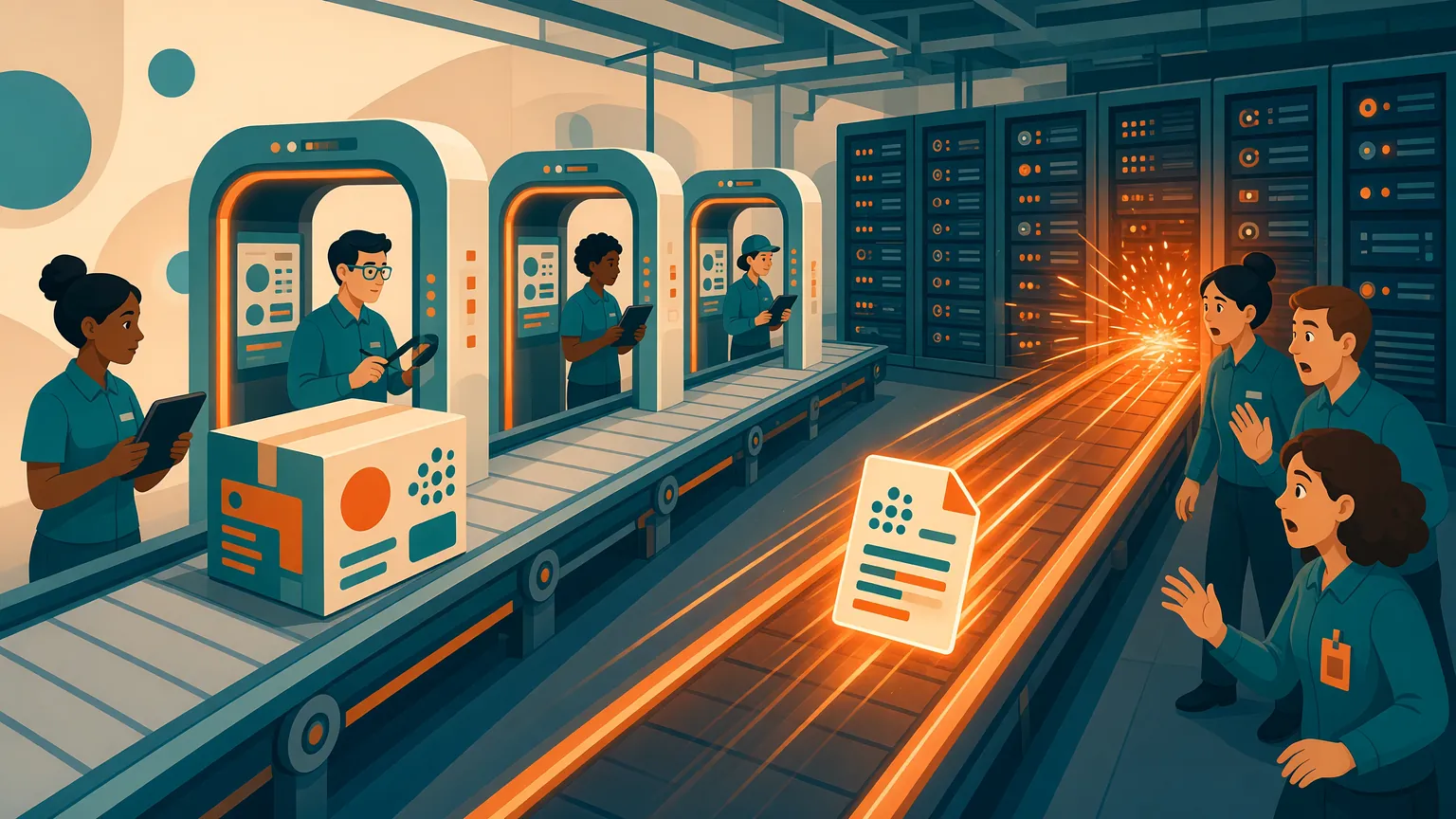
On November 18, 2025, at 11:20 UTC (5:20 a.m. Central), Cloudflare's network began failing to deliver core traffic. Sites that sit behind it returned error pages. Core traffic was largely flowing again by 14:30 UTC, and every system was back to normal by 17:06 UTC. Cloudflare's CEO called it the company's worst outage since 2019.
No attacker was involved, and no new software release was being deployed. According to Cloudflare's own postmortem, a database permissions change caused a query to return duplicate rows. Those rows went into a "feature file" that feeds the Bot Management system. The file doubled in size, past a limit of 200 features that the proxy software preallocates memory for, and it was then pushed to every machine in the network. The software hit the limit and failed.
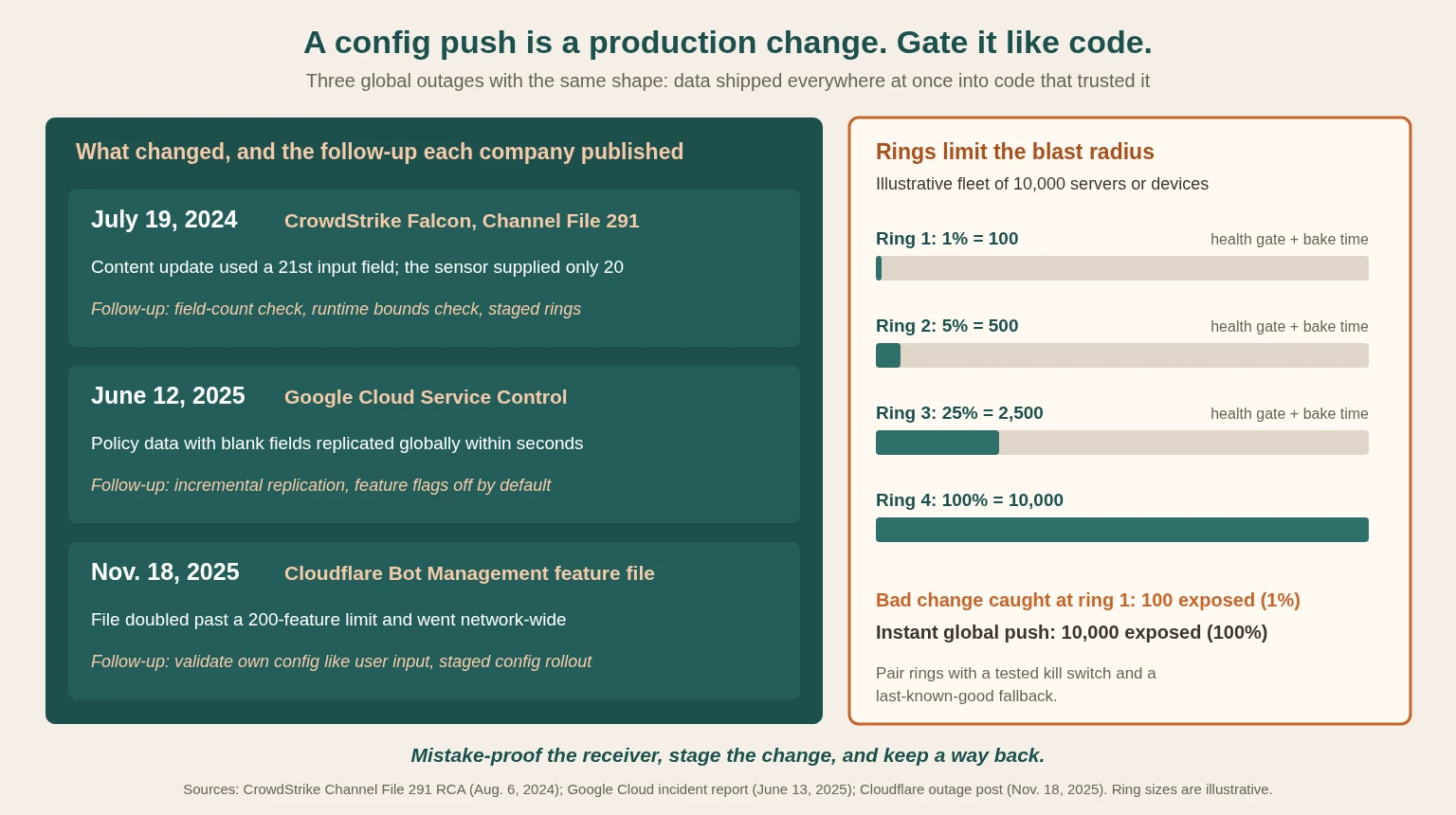
It was not the first outage with that shape. On July 19, 2024, a CrowdStrike content update, Channel File 291, crashed Windows machines that ran its Falcon sensor; Microsoft estimated about 8.5 million devices were affected. CrowdStrike's root cause analysis found that the update used a 21st input field when the sensor code supplied only 20, and that the mismatch had slipped past several layers of validation and testing. On June 12, 2025, Google Cloud's API management system crashed in every region after a policy change with unintended blank fields was replicated globally within seconds and hit a new code path that had no error handling and no feature flag.
Three companies with deep engineering benches. In each case, the thing that broke production was data or configuration, not a code release, and it reached everything at once.
Naming the failure: the Fast Lane
We call it the Fast Lane. Most technology organizations have built real gates for code: review, automated tests, staged rollouts, automatic rollback. Then, right beside that process, sits a second path for "just config": feature flags, rules files, detection content, model files, pricing tables, routing policies. That path skips most of the gates, because speed is the point of it.
Cloudflare said exactly this in its December 2025 resilience plan. Software releases went through controlled, monitored, gated deployment. Configuration changes did not: through its internal Quicksilver system, a change could reach about 90% of servers within seconds. Its own conclusion was that near-instant deployment "is rarely necessary."
The Fast Lane is not a software-only habit. On a plant floor it looks like a recipe parameter, a PLC setpoint, or an MES master-data change that goes straight to every line while a hardware change waits for a full management of change review. You can spot it when you ask "what changed in production last week?" and the answer lists releases but not configuration.
This matters now. Black Friday is November 27 and Cyber Monday is November 30. Many teams are about to freeze code releases for the peak, but in a lot of organizations the Fast Lane stays open during the freeze, because the business still needs to change prices, rules, and content.
Why this is a mistake-proofing problem, not a carelessness problem
It is tempting to read these postmortems and look for the engineer who should have caught it. The reports point somewhere more useful. Each failure needed a bad input and a receiving process that trusted it, and each fix was a design change, not a reminder. Three Lean ideas fit:
- Mistake-proof the receiving process. Poka-yoke puts the check where the error would do damage, so a wrong input cannot proceed. CrowdStrike added a compile-time check on the number of input fields and a runtime bounds check. Cloudflare committed to hardening the ingestion of its own generated configuration files "in the same way we would for user-generated input." In the terms of our mistake-proofing guide, that is a fixed-value check: a file with more than the allowed number of entries, or a blank required field, gets rejected before it is used.
- Run a first article before full production. A plant would not change a setting on every line at once without checking the first part. Staged rollout does the same job for configuration: release to a small ring, watch defined health measures for a bake period, then widen. CrowdStrike's mitigations include canary testing and successive deployment rings with bake-in time. Google committed to propagating globally replicated data incrementally, with time to validate and detect issues. Cloudflare built a component called Snapstone to give configuration the same health-mediated rollout and automatic rollback as code; it reported the Code Orange work complete in May 2026.
- Stop safely, and keep a way back. Jidoka means a process stops itself when something is abnormal instead of passing the defect on. Software has a useful variation: when new configuration cannot be read, keep running on the last known good version. Cloudflare now calls this "fail stale," with fail open or fail closed chosen deliberately for each case. Google noted that its emergency off switch was ready in about 25 minutes, but recovery in one large region still took up to about 2 hours 40 minutes, because restarting tasks overloaded a shared database without randomized backoff. A way back has to be tested, not just built.
The chart's ring example is illustrative, but the arithmetic is the point: on a fleet of 10,000, a bad change caught at a 1% first ring reaches 100 machines. Pushed everywhere at once, it reaches all 10,000 before anyone can react.
How to close the Fast Lane before peak week

You do not need a platform rebuild to start. You need an honest list and a few targeted controls on the riskiest items:
- Inventory every Fast Lane: List each way production behavior can change without a code release: feature flags, rules and policy files, model and detection content, pricing and catalog data, routing and DNS, and on the plant side recipes, setpoints, and master data. For each one, write down who can change it, how fast it reaches production, and how much of production it reaches at once.
- Score them with an FMEA, not a hunch: Run a quick FMEA on the list. The failure mode to look for is "bad value reaches every consumer at once." Rank by severity of a global failure and by how weak your detection is before the change spreads. The FMEA action priority tool helps. Work the top three first.
- Put a fixed-value check at the receiver: For each high-risk item, make the consuming system validate what it receives: schema, required fields, size and count limits, allowed ranges. Make a failed check reject the new file and keep the old one, rather than crash. Test it on purpose with a malformed file, the way you would test a sensor with a known bad part.
- Stage the change and define the health gate: Send configuration through rings, just like code: internal or test first, then a small share, then wider. For each ring, name the two or three health measures that decide whether it proceeds, such as error rate, latency, or crash count, and how long to wait. If a measure goes bad, roll back automatically.
- Build and drill the andon: Every high-risk Fast Lane needs a kill switch that stops further propagation and restores the last known good version, plus a way to reach it when your own tools are down. Run a short drill before November 27. Time it. Cloudflare's plan also called for removing circular dependencies from its break-glass procedures so teams can act fast during an incident.
- Count config failures as change failures: DORA's change fail rate is the share of deployments that need immediate intervention, such as a rollback or hotfix. Include configuration changes in that count, and review each one with a blameless postmortem. Our incident management and postmortems guide and quality gates and delivery metrics guide cover the mechanics. If configuration is excluded, your stability metric is hiding the riskiest path you have.
Practical takeaways for this week's Gemba walk
Spend an hour where changes actually happen, not in the change policy:
- Ask for last week's change list, then ask what is missing: Sit with the on-call or release team and compare the official change log against flag flips, rule edits, and data pushes. Every gap is a Fast Lane.
- Follow one config change end to end: Pick one recent flag or rules change and trace it from the person who made it to the last server or line it reached. Note where it was checked and how long it took to reach everything.
- Ask, "If this file were twice its normal size tomorrow, what would happen?": If nobody knows, or the answer is "it would crash," you have found your first mistake-proofing project.
Slow the change down, not the business
The lesson from these three outages is not that configuration is dangerous or that teams should stop changing things during peak season. It is that the fastest path into production deserves at least the same gates as the slowest one. Mistake-proof the receiver, stage the change, keep a last known good version, and practice stopping. Those are old ideas from the shop floor, and they work just as well on a server fleet.
Educational use only: this issue is written from a quality and operations perspective. Incident details are summarized from each company's published postmortem or root cause analysis; read the originals before drawing conclusions about any vendor. The ring example is illustrative.
Next Issue Preview
Next time we pick another corner of the improvement toolbox, chosen from what is happening on real floors this month. Stay tuned.
Call to Action
Before your peak-season freeze starts, list every way production can change without a code release, and mark the ones that reach everything at once. Pick the riskiest one and ask what would happen if its next file were malformed. Send me what you found, anonymized. P.S. Share this with your release manager, your site reliability lead, and whoever owns recipe and master-data changes on your plant floor.
Newsletter replies and questions: [email protected]
Follow updates on X.com: @kaizen6sigma
References
- Matthew Prince, Cloudflare, "Cloudflare outage on November 18, 2025" (Cloudflare Blog, November 18, 2025)
- Cloudflare, "Code Orange: Fail Small, our resilience plan following recent incidents" (Cloudflare Blog, December 19, 2025)
- Cloudflare, "Code Orange: Fail Small is complete. The result is a stronger Cloudflare network" (Cloudflare Blog, May 1, 2026)
- CrowdStrike, "External Technical Root Cause Analysis: Channel File 291" (August 6, 2024)
- Microsoft, "Helping our customers through the CrowdStrike outage" (Official Microsoft Blog, July 20, 2024)
- Google Cloud Service Health, incident report for the June 12, 2025 Service Control outage (report summary posted June 13, 2025)
- DORA, "DORA's software delivery performance metrics" (dora.dev, last updated January 5, 2026)