
The Problem: The frame is perfect and the decisions are not

Last issue ended with a promise: the ISO 9001:2026 quality policy, and what it takes for a policy to be understood and applied, not just communicated. This is that issue.
Here is how most plants will handle it. Quality prints a fresh copy of the policy on heavier paper, gets a new signature from the plant manager, and hangs it in the lobby next to the certificates. Someone updates the intranet page. The annual all-hands includes one slide that restates the four paragraphs. When the auditor asks how the organization establishes and communicates its quality policy, the quality manager walks them to the frame.
Now walk out to the line and ask an operator: "We are behind on the order and a measurement comes in right on the limit. What does our quality policy tell you to do?" If the answer is a shrug, a glance at the supervisor, or "I think it's on the wall by the break room," the frame is not telling you what you think it is.
Naming the failure: the Lobby Frame Proxy
We call this the Lobby Frame Proxy. Presence stands in for application, because a frame is easy to photograph and a decision is not.
A framed policy proves that top management signed something. It does not show that the wording fits this plant's purpose and context, that it supports the strategic direction the leadership team is actually pursuing, that quality objectives trace back to its commitments, or that people use it when quality and schedule collide. Those are the things Clause 5.2 asks for, and from the 2026 edition onward the standard is clearer that "communicated" is not enough.
The Lobby Frame Proxy also hides who was never reached. The off-shift that never walks through the lobby, the contractor who enters through the side gate, the temp who started after the all-hands. All of them count as "done" once the frame is up.
What Clause 5.2 actually asks for in the 2026 edition
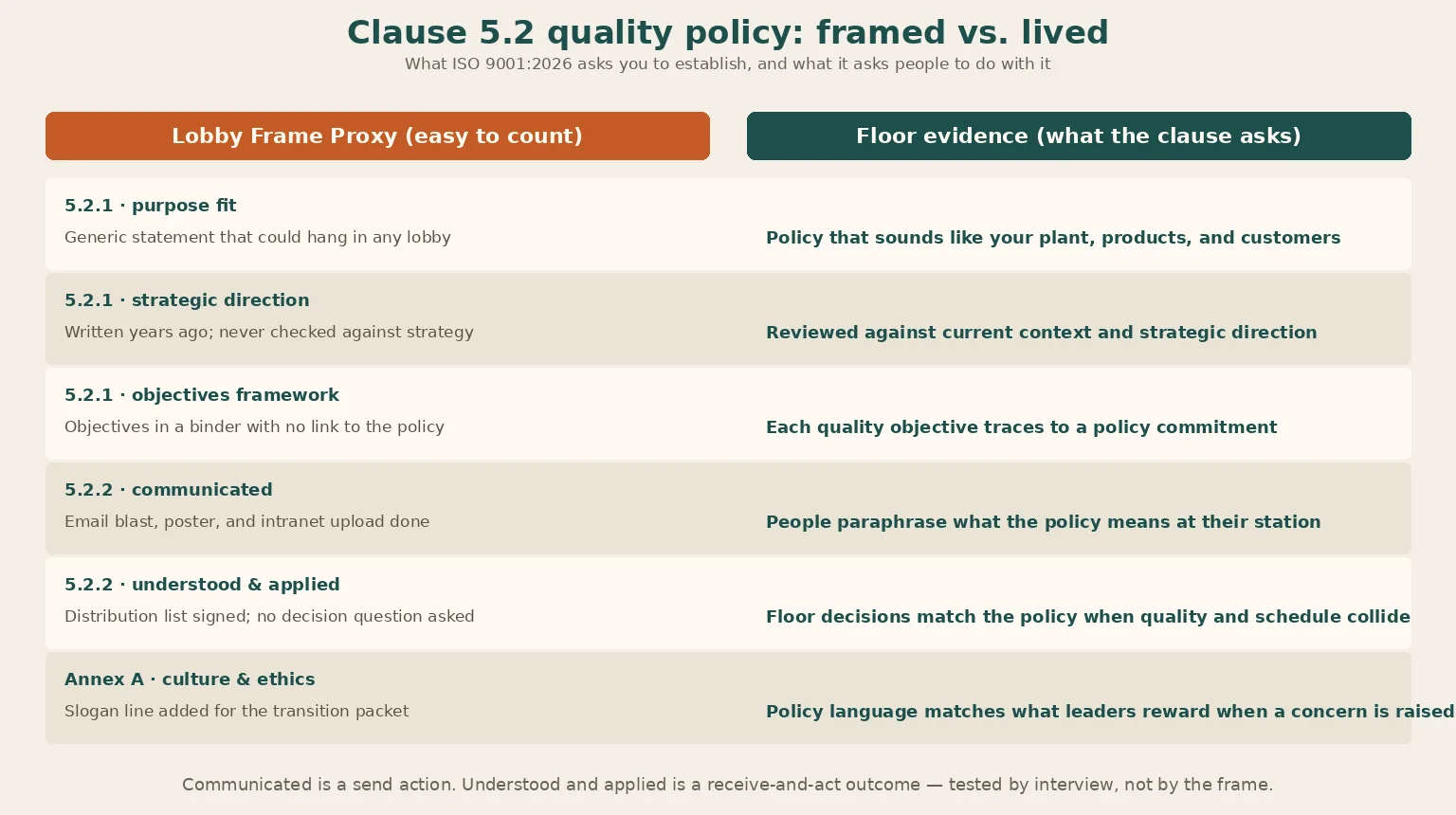
ISO 9001:2026 was published on 16 September 2026. Among the main changes ISO itself names is closer alignment with business strategy: the quality policy is more explicitly linked to the organization's context and strategic direction, reinforcing the QMS as a tool for achieving business objectives rather than simply maintaining compliance. That is Clause 5.2.
Two subclauses do the work. Clause 5.2.1 covers establishing the policy. Top management must establish a quality policy that is appropriate to the purpose of the organization, provides a framework for setting quality objectives, includes a commitment to satisfy applicable requirements, includes a commitment to continual improvement of the QMS, and — in a change the 2026 edition makes more visible — takes into account the context of the organization and supports its strategic direction. In the 2015 edition, purpose and context sat together in one criterion. The 2026 edition keeps purpose where it was and moves context into its own criterion alongside strategic direction, so the policy now has five establishing tests instead of four.
Clause 5.2.2 covers communicating the policy. It must be available as documented information, be communicated within the organization, be available to relevant interested parties as appropriate, and be implemented, understood, and applied within the organization. MSI's line-by-line review of the published text puts the point cleanly: communicated is a send action; understood and applied is a receive-and-act outcome, and it is tested by interview rather than by a distribution list. Annex A adds that the quality policy can reflect the organization's quality culture and its expectations for ethical behaviour — the cleanest single place to connect the policy to the new Clause 5.1.1 duty on promoting quality culture and ethical behaviour, and to the Clause 7.3 awareness item we covered last issue.
Three details matter more than they look:
- Strategic direction is not a slogan. If your three-year plan is about a new product family, a tighter supplier base, or a different customer mix, the policy should still make sense when you read it next to that plan. A policy that could hang in any lobby fails the new criterion.
- Awareness of the policy and application of the policy are different tests. Clause 7.3 asks whether people are aware of the quality policy. Clause 5.2.2 asks whether the policy is implemented, understood, and applied. You can recite a sentence from the frame and still release a borderline part because "the truck is waiting."
- Application is shown by decisions, not by the wall. The only way to check that the policy is applied is to watch or ask about a real decision where the policy should have constrained the choice.
Timing still gives you room. DNV reports that the transition period is three years and that ISO 9001:2015 certificates cease to be valid after 30 September 2029. A policy rewrite is a short edit. Getting people to use it is the longer piece of work, so start with the decisions, not the frame.
How to make the policy something people use

You do not need a new policy campaign. You need the policy you already have to survive contact with the floor. Here is a sequence that fits Clause 5.2 and keeps the evidence where decisions happen:
- Read the policy against your strategy, not against the clause list: Sit the current policy next to this year's strategic priorities and your Clause 4.1 context. Cross out any sentence that could belong to a different company. Rewrite until a stranger could tell what you make and what you refuse to trade away.
- Translate each commitment into station language: For every commitment in the policy, write one plain sentence per major work area. "At this press, meeting requirements means we do not ship a part that sits on the limit without a second check and a named decision." If the supervisor cannot write the sentence, the operator will not be able to apply it.
- Connect objectives to the policy in one line each: For each quality objective under Clause 6.2, add a single sentence that names which policy commitment it supports. If you cannot write that sentence, the objective is floating free of the framework Clause 5.2.1 requires.
- Test application with decision questions, not recitation: Replace "What is our quality policy?" with "We are late and this result is on the limit. What does the policy tell you to do, and what happens next?" Record the answers in the person's own words. A weak answer is a signal that the message did not land, not a disciplinary event.
- Close the loop when someone uses the policy: When a person stops a shipment, raises a concern, or asks for a second check because of the policy, tell the team what happened next. Clause 5.1.1 leaders who promote quality culture and Clause 5.2.2 people who apply the policy should be describing the same event.
- Cover the people the lobby never sees: Add contractors, agency staff, and new starters to the decision-question checks. Look first at anyone who entered through a door that does not pass the frame.
Keep the frame if you want it for visitors. Just stop treating it as the evidence.
Practical takeaways for this week's Gemba walk
Take the Clause 5.2 list to the floor and test it:
- Ask the application question three times: Ask three people in one area, including one temp or contractor: "We are behind and a result is on the limit. What does our quality policy tell you to do?" Write the answers word for word.
- Compare with the frame: Stand in front of the lobby policy and read it against those three answers. If the frame is perfect and the answers disagree, you have found the Lobby Frame Proxy.
- Check one objective: Pick one quality objective from the management review pack. Can you name, in one sentence, which policy commitment it supports? If not, the framework test in 5.2.1 is already failing.
A policy is something people use, not something you hang
Clause 5.2 now asks for a quality policy that fits your purpose and context, supports your strategic direction, and is implemented, understood, and applied. No frame can show that. An operator explaining, without a script, what the policy tells them to do with a borderline part can. Build your policy work so that answer becomes normal, and record it the same way. In our next discussion, we will look at organizational knowledge in ISO 9001:2026 and what it takes for knowledge to be retained, applied, and shared — not just filed.
Next Issue Preview
Next up: organizational knowledge under ISO 9001:2026. We look at why a document library is not the same as knowledge that is retained, applied, and shared when people leave or processes change. Stay tuned.
Call to Action
Ask one operator the application question this week. What did they say, and did it match the framed policy in your lobby? Send me the answer, anonymized, and the station sentence you would write for that area. P.S. Share this with whoever owns your quality policy document.
Newsletter replies and questions: [email protected]
Follow updates on X.com: @kaizen6sigma
References
- ISO, "ISO 9001:2026: What businesses need to know"
- ISO 9001 Help, "5.2 Quality Policy" (ISO 9001:2026 guidance)
- MSI, "ISO 9001:2026 Is Published: The Truth About What Changed"
- DNV, "ISO 9001:2026 Standard Revision"
- ISO 9001:2015 on the ISO Online Browsing Platform (Clause 5.2, 2015 wording)
- ISO, "ISO 10010:2022 Quality management: Guidance to understand, evaluate and improve organizational quality culture"