The Problem: The folder is full and the know-how is walking out the door

Last issue ended with a promise: organizational knowledge under ISO 9001:2026, and why a document library is not the same as knowledge that is retained, applied, and shared. This is that issue.
Here is how most plants will handle it. Someone builds a "knowledge" folder on the shared drive, or a new page in the eQMS. Work instructions, setup sheets, old 8D reports, and a few lessons-learned slides get dropped in. A procedure is written that says the organization determines, maintains, and makes available the knowledge it needs. When the auditor asks about Clause 7.1.6, the quality manager opens the folder and scrolls.
Now go to the press that only runs well when one setup technician is on shift. Ask the night-shift operator: "When this tool starts to flash on the parting line, what do you change first, and how do you know?" If the answer is "We wait for Ray in the morning," the folder is not telling you what you think it is. And if Ray retires next spring, it never will.
Naming the failure: the Shared Drive Proxy
We call this the Shared Drive Proxy. Storage stands in for knowing, because a folder is easy to show and a person's judgment is not.
A full folder proves that someone saved documents. It does not show which knowledge your processes and results actually depend on, who holds it, whether the person at the task can reach the current version, or whether what one shift learned last week has reached the other two. Those are the things Clause 7.1.6 asks about, and the 2026 edition changed the verbs to make that harder to dodge.
The Shared Drive Proxy also hides what was never written down. The ISO 9001 Auditing Practices Group made the point back in 2016: tacit knowledge, and knowledge from experience, is not something document control alone can make available and usable. Its paper also warns auditors that having documented information does not necessarily mean the organization's knowledge is appropriately determined.
What Clause 7.1.6 actually asks for in the 2026 edition
ISO 9001:2026 was published on 16 September 2026. Organizational knowledge is not one of the headline changes in the foreword, and ISO treats it as one of the smaller refinements. The wording change is small. The practical effect is not.
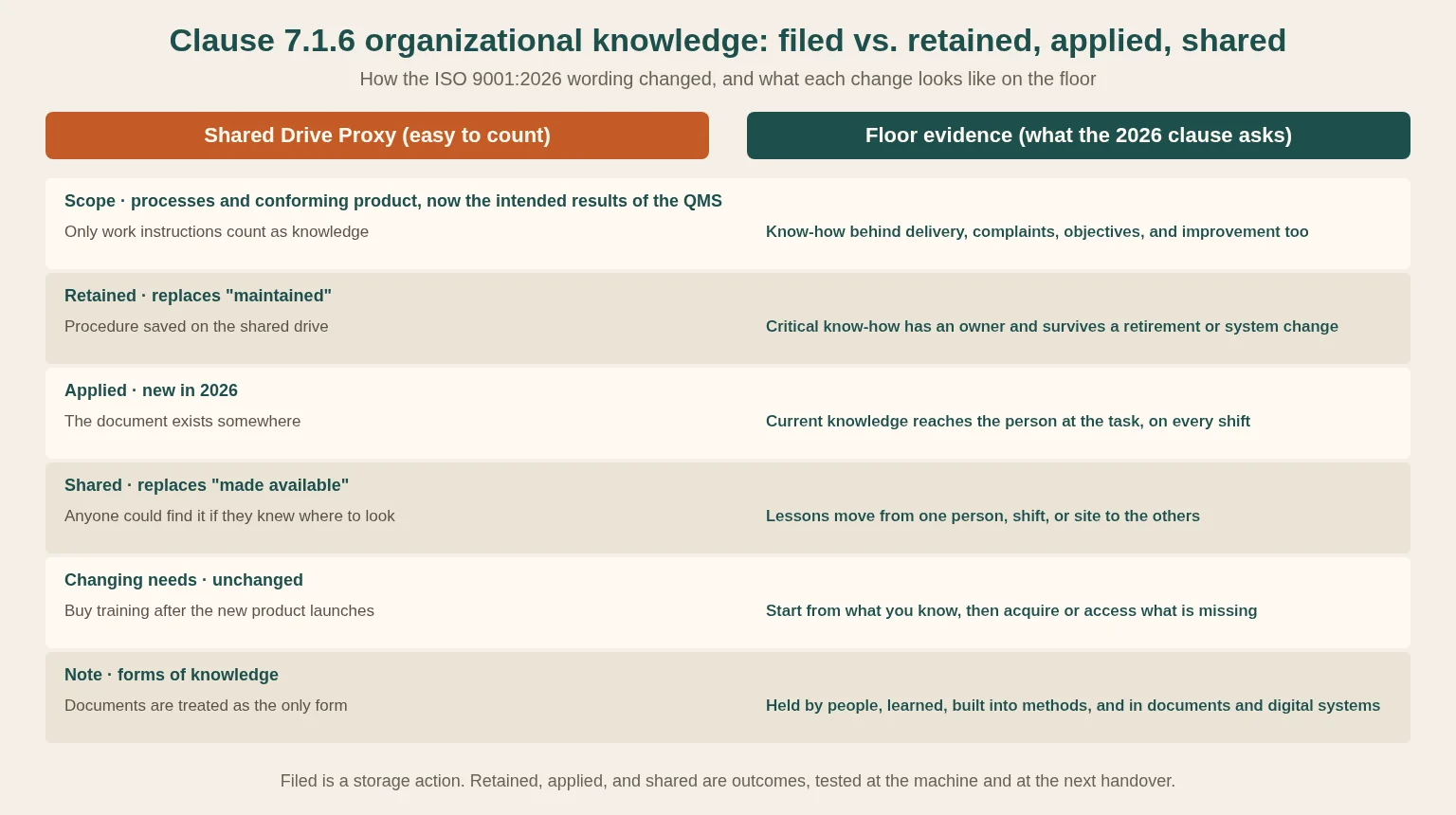
The clause keeps its title and its structure, and three things move. First, the scope widens. In 2015 the knowledge was what you needed to operate your processes and achieve conformity of products and services. In 2026 it is the knowledge needed to operate processes and achieve the intended results of the quality management system, so it now reaches customer satisfaction, objectives, and improvement as well as conforming product. Second, the verbs change. Where 2015 asked for knowledge to be maintained and made available to the extent necessary, 2026 asks for it to be retained, applied, and shared to the extent necessary. AFNOR, the French standards body, summarizes the same shift in its own overview. Third, the note now describes the forms knowledge takes: held by people through experience, gained through education, training, and learning from others, embedded in methods, processes, and products, and represented in documented information, digital systems, and other media.
The part that did not change still matters. When needs and trends change, you start from the knowledge you already have and decide how to acquire or access what is missing. The new Annex A section A.7.1.6 describes organizational knowledge as dynamic, updated through use and experience, and points to ISO 30401, the knowledge management systems standard, as further reading. ISO 9001 does not require an ISO 30401 system.
Three details matter more than they look:
- Retained is about surviving change. Maintaining a document keeps it current. Retaining knowledge means it is still in the building after a retirement, a resignation, a supplier change, or a software migration.
- Applied is new, and it is tested at the task. Knowledge that is kept but never used does not meet the clause on its own. Clause 8.5.1 now says documented information for production and service provision must be available and used, and the 2026 edition defines competence as the ability to apply knowledge and skills to achieve intended results. Those three clauses point at the same moment: the person doing the work.
- Shared means the knowledge moves. "Made available" was satisfied if someone could find it. "Shared" asks whether a lesson learned on one shift, line, or site actually reaches the others.
Clause 7.1.6 still requires no documented information, in 2015 or in 2026. You decide what evidence fits. Timing also gives you room: DNV reports a three-year transition, with ISO 9001:2015 certificates ceasing to be valid after 30 September 2029. The knowledge you are most likely to lose before then is not in a folder, so start with people, not storage.
How to make knowledge stay, get used, and move

You do not need a knowledge management platform to start. You need to know which knowledge you would miss first, and make sure it stays, gets used, and moves. Here is a sequence that fits Clause 7.1.6 and keeps the evidence where the work happens:
- Map knowledge to results, not to folders: For each core process, list the knowledge it depends on to hit its results: setup, troubleshooting, customer requirements, the reasons behind past changes. Note who holds it and in which form: in a person, in training, built into the method or fixture, or written down. The rows that exist only "in a person" are your exposure.
- Rank the single points of failure: Mark each knowledge item that depends on one person, one shift, or one retiring system. Ask "If this person were gone tomorrow, what would we stop being able to do?" Treat the answer like a risk under Clause 6.1, with an owner and a date.
- Retain it before the leaving date, not after: For each critical role, agree a plan while the expert is still here: paired shifts, recorded walk-throughs at the machine, and a successor who performs the task while the expert watches. The APG paper names mentoring and succession planning as ways to capture knowledge that sits in people's heads.
- Put the knowledge at the point of use: If the night-shift operator cannot reach the current setup sheet or troubleshooting guide from the machine, the knowledge exists but is not applied. Move it to where the decision happens, in a form someone can use with gloves on.
- Make lessons travel: When a corrective action under Clause 10.2, a near miss, or a successful kaizen changes how a job should be done, close it only when the method, the instruction, and the people on every affected shift have the change. A lesson that stays in the 8D report is filed, not shared.
- Check knowledge before you change things: When you plan a change under Clause 6.3, the 2026 edition asks you to consider whether the information is available. Before a new product, machine, or system goes live, ask what knowledge the change needs, who has it, and how you will get what is missing. That is the "changing needs and trends" part of 7.1.6 in practice.
Keep the shared drive. It is one of the four forms knowledge takes. Just stop treating it as the evidence.
Practical takeaways for this week's Gemba walk
Take the Clause 7.1.6 verbs to the floor and test them:
- Ask the "who would we miss" question: In one area, ask the supervisor and two operators: "Whose absence would stop this line from running well?" Write down the names and the tasks. That is your first retention list.
- Test application on the off-shift: Pick one recurring problem and ask an operator on a different shift what they do when it happens. Compare the answer with the instruction and with the expert's answer. Three different answers mean the knowledge is not shared.
- Trace one lesson: Take one closed corrective action from the last quarter. Can you find the changed method at the station, and does every shift do it the new way? If not, you have found the Shared Drive Proxy.
Knowledge is something people carry, not something you store
Clause 7.1.6 now asks for knowledge that serves the intended results of your quality management system and is retained, applied, and shared. No folder can show that. A night-shift operator fixing the problem the way the expert would, without waiting for morning, can. Build your knowledge work so that becomes normal, and record it the same way. In our next discussion, we will look at interested parties under ISO 9001:2026 and what it means to decide which of their requirements your quality management system will address.
Next Issue Preview
Next up: interested parties under ISO 9001:2026 Clause 4.2. We look at why a stakeholder table copied from the last audit is not the same as deciding which requirements your system will actually address, and how to keep that list current. Stay tuned.
Call to Action
Ask one supervisor the "who would we miss" question this week. Which task came up first, and does anyone besides that person know how to do it? Send me the answer, anonymized, and the first step you would take to retain it. P.S. Share this with whoever is planning your next retirement or system migration.
Newsletter replies and questions: [email protected]
Follow updates on X.com: @kaizen6sigma
References
- ISO, "ISO 9001:2026: What businesses need to know"
- ISO 9001 Help, "7.1.6 Organizational Knowledge" (ISO 9001:2026 guidance)
- Elium, "What changes in ISO 9001:2026, and what it means for organisational knowledge"
- AFNOR, "ISO 9001 Quality Standard: Introducing the New 2026 Version"
- ISO 9001 Auditing Practices Group, "Guidance on: Organizational Knowledge" (ISO/TC 176 and IAF, 2016)
- DNV, "ISO 9001:2026 Standard Revision"
- ISO 9001:2015 on the ISO Online Browsing Platform (Clause 7.1.6, 2015 wording)