The Problem: The training record says everyone is aware

Last issue ended with a promise: Clause 7.3 and the new awareness of quality culture and ethical behavior. This is that issue.
Here is how most plants will handle it. The quality team builds a 20-minute briefing on the 2026 changes, with a slide on quality culture and a slide on ethics. Supervisors run it at the start of each shift. Everyone signs the sheet. Temporary staff watch a short video at the agency's induction. The sign-in sheets are scanned and filed, and the training matrix turns green. When the auditor asks how the organization ensures awareness, the quality manager opens the folder.
Now walk out to the line and ask an operator: "It's the last hour of the shift and a measurement comes in right on the limit. What do you do, and what happens next?" If the answer is a shrug, a nervous glance at the supervisor, or "depends who's on," the folder is not telling you what you think it is.
Naming the failure: the Sign-In Sheet Proxy
We call this the Sign-In Sheet Proxy. Attendance stands in for understanding, because attendance is easy to count and understanding is not.
A signature proves that someone was in the room. It does not show that they can connect the quality policy to the work at their station, that they know what happens to the customer if a check is skipped, or that they believe they can raise a concern near the end of a shift without paying for it. Those are the things Clause 7.3 asks for, and from the 2026 edition onward the last one is written into the clause.
The Sign-In Sheet Proxy also hides who was never reached. The off-shift that got a shortened version, the contractor who started the week after the briefing, the temp who watched the video on a phone in the break room. All of them count as "done" on the matrix.
What Clause 7.3 actually asks for in the 2026 edition
ISO 9001:2026 was published on 16 September 2026. ISO lists "greater emphasis on people" among its main changes: new awareness requirements in Clause 7.3 that recognize quality depends not only on effective processes but also on people's understanding of quality culture and ethical behaviour. The standard's own foreword says quality culture and ethical behaviour are now addressed in the requirements, particularly in relation to leadership, awareness, and the environment for the operation of processes. DNV's summary places them in the same three clauses: 5.1.1, 7.3, and 7.1.4.
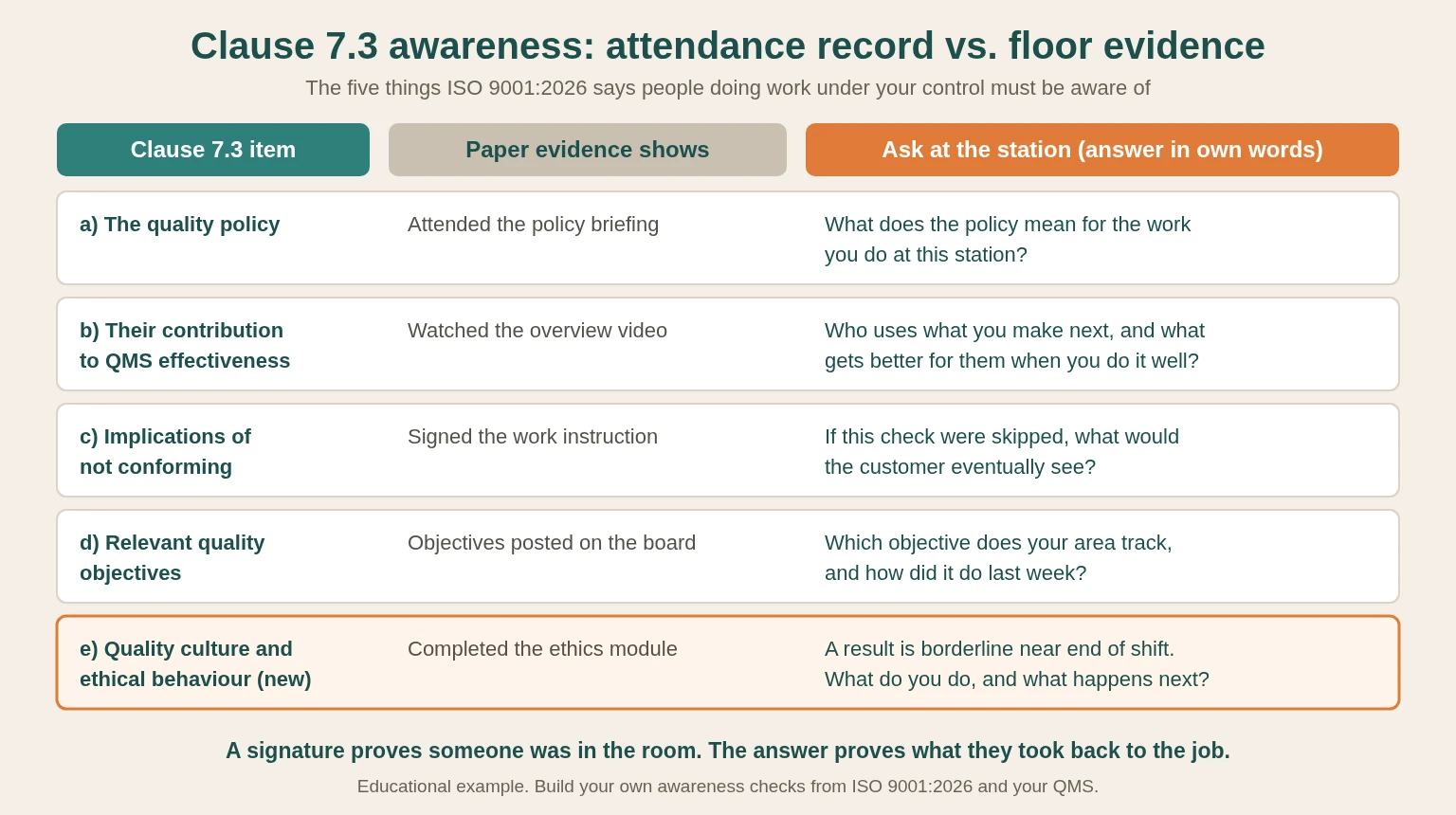
The structure of the clause is familiar. In the 2015 edition, Clause 7.3 required people doing work under the organization's control to be aware of four things: the quality policy, relevant quality objectives, their contribution to the effectiveness of the quality management system (including the benefits of improved performance), and the implications of not conforming. As MSI's line-by-line review of the published text describes it, the 2026 edition keeps those four and adds a fifth: awareness of the organizational quality culture and ethical behaviour. MSI also notes that the new Annex A links awareness to behaviours aligned with the quality policy and objectives, and points readers to ISO 10010 for guidance on quality culture.
Three details matter more than they look:
- "Persons doing work under the organization's control" is wider than the payroll. If a temp, a contractor, or a supplier's technician does work under your control, the awareness requirement reaches them too.
- Awareness is not competence. Clause 7.2 is about whether people can do the job, and it has required since 2015 that you evaluate the effectiveness of actions such as training. Clause 7.3 is about whether people understand why the job matters and what is expected of them. You can be fully competent at a crimping operation and still believe the line keeps running when a gauge is out of calibration.
- Awareness is shown by the person, not by the file. The clause says people are to be aware. The only way to check that is to ask them, in their own words, at their own station.
ISO 10010:2022 is the guidance standard to keep beside you. It covers how to understand, evaluate, and improve organizational quality culture, focusing on people engagement and leadership, and it includes example self-assessment tools for judging quality culture maturity. It is guidance, not a requirement, but it is the closest thing to a playbook for the new item (e).
Timing gives you room. DNV reports that the transition period is three years and that ISO 9001:2015 certificates cease to be valid after 30 September 2029. Culture takes longer to change than a procedure, so the awareness work is the item to start first, not last.
How to build awareness you can actually check

You do not need an awareness program. You need your existing touch points, such as onboarding, huddles, and leader standard work, to produce understanding you can see. Here is a sequence that fits Clause 7.3 and keeps the evidence on the floor:
- Translate the five items into station language: For each work area, write one plain sentence per Clause 7.3 item. "At this press, the policy means we stop and call when a part looks wrong, even at the end of a run." If the supervisor cannot write the sentence, the operator will not be able to say it.
- Use real scenarios, not slides: For item (e), build three or four short situations from your own history: a borderline result at the end of a shift, a customer asking for a date you know you cannot meet, a coworker skipping a check. Discuss them in huddles. The goal is that people know what the expected behavior is and what happens after they do it.
- Close the loop with leaders' actions: Awareness of quality culture only sticks if it matches what people see. When someone stops the line or raises a concern, tell the team what happened next. A Clause 5.1.1 leader who promotes ethical behavior and a Clause 7.3 operator who is aware of it should be describing the same event.
- Check by asking, and record the answers: Replace part of the sign-in sheet with a short station check. A supervisor asks two or three of the questions from the infographic and notes the answers in the person's own words. A weak answer is not a disciplinary issue. It is a signal that the message did not land, and it goes back into the next huddle.
- Cover everyone the clause covers: Add agency staff, contractors, and new starters to the station check, not just the annual briefing. Look first at the people who joined after the last round of training.
- Feed the results into audit and review: Summarize the station checks by area and item. Where answers to item (e) are weak, that is input for your internal audit programme and your management review, not a training records problem.
Keep the sign-in sheet if you need it for other reasons. Just stop treating it as the evidence.
Practical takeaways for this week's Gemba walk
Take the Clause 7.3 list to the floor and test it:
- Ask the item (e) question three times: Ask three people in one area, including one temp or contractor: "A result is borderline near the end of the shift. What do you do, and what happens next?" Write down the answers word for word.
- Compare with the matrix: Check the training matrix for the same three people. If all three show green and the answers disagree, you have found the Sign-In Sheet Proxy.
- Find the gap in coverage: List everyone who started in that area since your last ISO 9001:2026 briefing. How many of them would you be comfortable letting an auditor interview?
Awareness is something people say, not something you file
Clause 7.3 now asks people to be aware of the organization's quality culture and ethical behavior. No folder can show that. An operator explaining, without a script, what they would do with a borderline part and why they are confident it is safe to do it can. Build your awareness work so that answer becomes normal, and record it the same way. In our next discussion, we will look at the quality policy in ISO 9001:2026 and what it takes for a policy to be understood and applied, not just communicated.
Next Issue Preview
Next up: the ISO 9001:2026 quality policy. We look at why a framed policy in the lobby is not the same as a policy people use to make decisions, and how to test the difference on the floor. Stay tuned.
Call to Action
Ask one operator the item (e) question this week. What did they say, and did it match your quality policy? Send me the answer, anonymized, and the scenario you would use in your next huddle. P.S. Share this with whoever owns your training matrix.
Newsletter replies and questions: [email protected]
Follow updates on X.com: @kaizen6sigma
References
- ISO, "ISO 9001:2026: What businesses need to know"
- ISO 9001:2026 sample pages, foreword and list of main changes (iTeh Standards preview)
- DNV, "ISO 9001:2026 Standard Revision"
- MSI, "ISO 9001:2026 Is Published: The Truth About What Changed"
- ISO 9001:2015 on the ISO Online Browsing Platform (Clauses 7.2 and 7.3, 2015 wording)
- ISO, "ISO 10010:2022 Quality management: Guidance to understand, evaluate and improve organizational quality culture"