
The Problem: The register is green and the defect is back
Last issue we pulled every improvement list into one pipeline and gave nonconformities their own lane. This issue is about what happens in that lane.
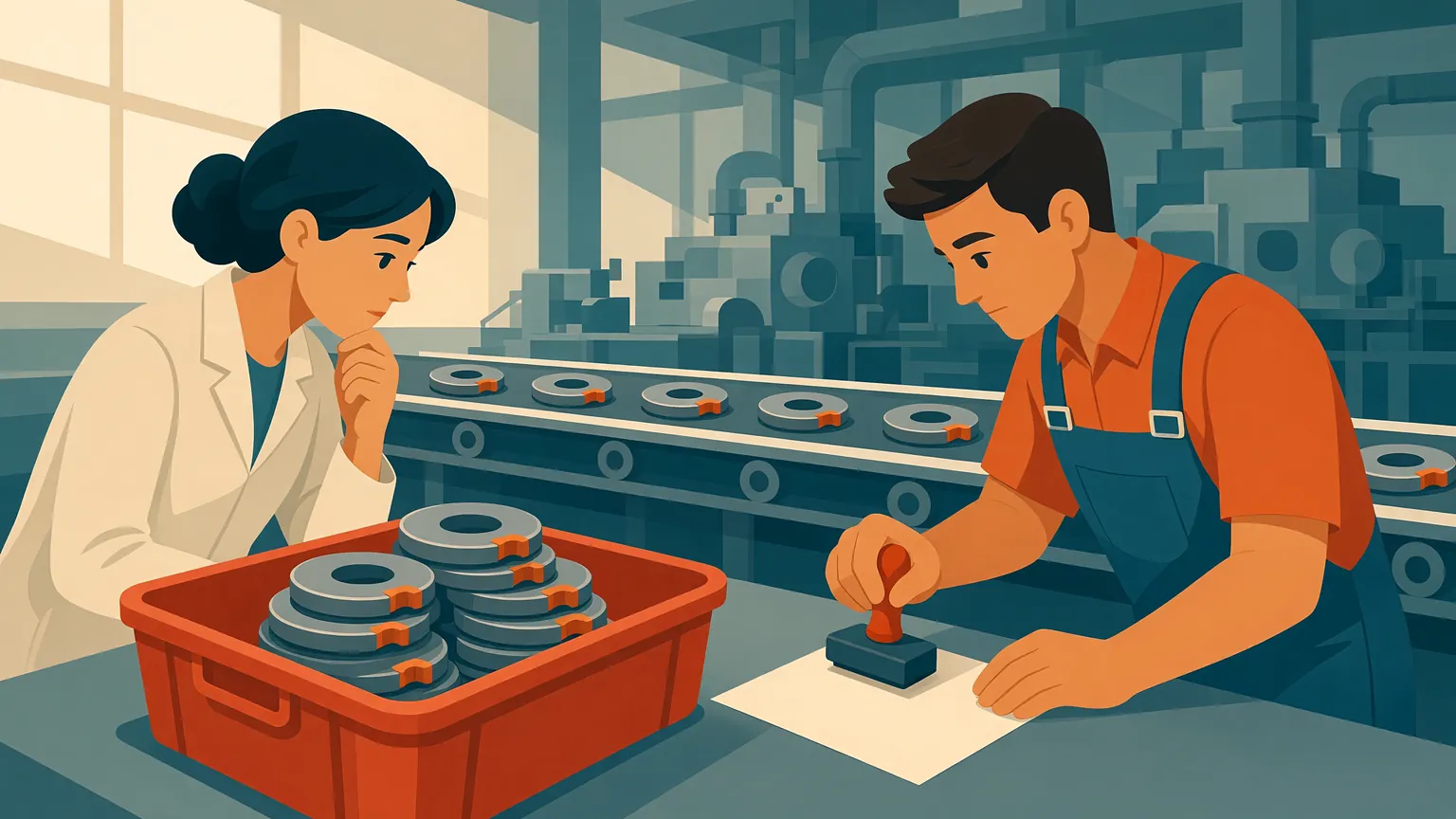
You know the pattern. A customer returns a lot with a missing feature. The parts get sorted and reworked, the operator gets retrained, and the corrective action closes in a week. Everyone signs. The dashboard turns green. Four months later, the same defect shows up on the second shift, or on the sister line, or at the same customer. A new corrective action opens, and nobody links it to the first one.
Auditors see this every day. Quality Field Guides, written from the lead auditor's side of the table, lists the findings that come up most under Clause 10.2: a correction recorded as a corrective action, a cause that stops at a person, an effectiveness review that is missing or done on the day of closure, every problem pushed through the same form, and repeat nonconformities with no escalation. If two or three of those sound familiar, you are not alone, and ISO 9001:2026 is a good moment to fix it.
Naming the failure: Closed on Paper
We call this Closed on Paper. It happens when the corrective action system measures completion instead of results. The form is complete, the training record is signed, the procedure revision is approved, so the action is closed. Nobody went back to check whether the problem stayed gone.
9001 Simplified puts the line plainly: completing training or changing a document is evidence of an action, not necessarily evidence of effectiveness. Quality Field Guides says the same thing from the audit side: a signature on the closure line is not evidence.
Closed on Paper usually rides with its partner, the cause that ends at a person. We covered that one in When 'Human Error' is a Stop Sign for Investigation. This issue picks up where that one ended: once you have a real cause, how do you prove the fix worked, and how do you make sure the same failure is not waiting somewhere else?
What Clause 10.2 looks like now
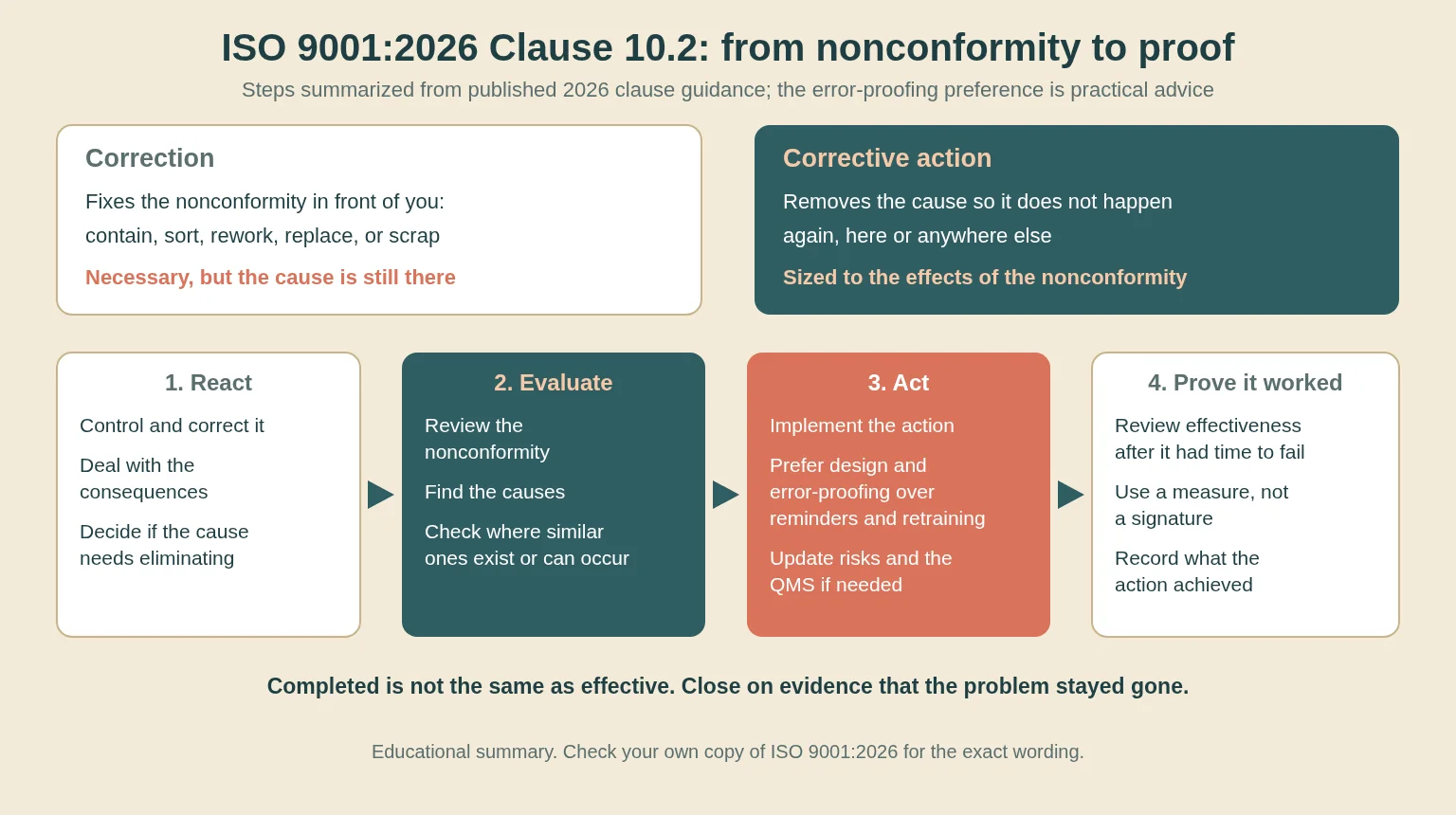
The good news is that Clause 10.2 did not get harder. ISO 9001 Help and Quality Field Guides both describe the 2026 requirements as unchanged in substance. The steps are the ones you already run. The wording and the guidance around them did move, and those small moves point at the Closed on Paper problem:
| Item | What changed in 2026 | What it means on the floor |
|---|---|---|
| The steps | Same sequence: react, control and correct, deal with consequences, evaluate the need to remove causes, act, review effectiveness, update risks and opportunities, change the QMS if needed | Your procedure probably does not need a rewrite. Your closure discipline might. |
| Complaints | The reference to customer complaints moved from the requirement text into a note saying complaints can be a source of nonconformities | Not every complaint is a nonconformity, but complaints should still reach the corrective action process, not live in a separate service loop. |
| Similar nonconformities | Still required: check whether similar nonconformities exist or can occur (the 2015 text said "could") | Look at the other line, the other shift, and the other product before you close. |
| Records | Documented information must be "available as evidence" of the nature of the nonconformity, the actions taken, and the results of corrective action | "Results" is the record most registers are missing. Write down what the action achieved, with data. |
| Annex A guidance | Quality Field Guides reports new informative guidance that the organization decides how far to investigate, weighing recurrence risk, impact, and customer requirements | Proportion is expected. A bent label and a shipped nonconforming part do not deserve the same investigation. |
| Link to 10.1 | Quality Field Guides notes the 10.1 note no longer lists correction and corrective action as examples of improvement | A full corrective action register is not, on its own, evidence of continual improvement. |
The same caution as last issue applies. These are summaries from published guidance, and the wording differs slightly between sources. Check your own copy of ISO 9001:2026 before you rewrite your procedure. DNV notes that ISO 9001:2015 certificates stop being valid after 30 September 2029, so you have time to do this properly.
The real cost of closing on paper
Closed on Paper costs you three ways. First, you pay for the same problem twice. The sort, the rework, the customer call, and the investigation all happen again when the defect returns, and the second round usually costs more because the customer is less patient.
Second, the register stops telling the truth. If every action closes and problems still repeat, the closure rate is measuring paperwork speed. Management review then makes decisions on a number that looks healthy and is not. Quality Field Guides flags repeat nonconformities with no escalation as a common finding for exactly this reason: the register does not know it has seen this before.
Third, proportion breaks in both directions. When every minor issue gets the full eight-step treatment, the serious ones wait in line and get the same shallow look. As Quality Field Guides puts it, a hundred open actions on trivia is as much a finding as none on the serious case.
Operationalizing the shift: 5 habits for corrective action that holds

None of this needs new software. It needs a few habits built into the form and the closure meeting:
- Record correction and corrective action as two separate things: Give them separate fields with separate owners and dates. The sort and rework go in the correction field. Only the change that removes the cause goes in the corrective action field. If the second field is empty, the action is not ready to close.
- Size the response before you start: Triage every nonconformity on recurrence risk and impact. A one-off with no risk of recurrence can be corrected and closed with that decision recorded. A shipped defect or a repeat gets a full investigation with your root cause tools. Write the reason for the depth you chose.
- Look sideways on every action: Ask where else the same failure can happen: the other shift, the mirror-image part, the sister line, the other site, the supplier who makes a similar component. Record the answer even when it is no. That is the "exist or can occur" step, and it is the one most often skipped.
- Pick the strength of the fix on purpose: Quality Field Guides suggests choosing the control level before the fix: eliminate the step, design the failure out, detect it automatically, warn, write a procedure, train. Fixes from "warn" down depend on people remembering under pressure, and they decay. If retraining is the only action, say why a stronger control was not possible.
- Define effectiveness at the start and check it later: When you open the action, write down the measure that will show the problem is gone and the date you will check it. Quality Field Guides uses a 90-day check: is the process still run the new way, what does the indicator say, has anything upstream changed, and would a new hire trained today do it the new way? Close on that answer, then update the risk register and report the result to management review.
Practical takeaways for this week's Gemba walk
Pick three recently closed corrective actions and take them to the floor:
- Find the fix: Go to the station where each fix was made. Is the fixture, the poka-yoke, or the new method still there and still used, or has a workaround appeared?
- Ask the four audit questions: For each action, can you answer what happened, why (with evidence), what was done, and how you know it worked? Note which question each one fails.
- Count the retrains: Look at your last twenty closed actions and count how many list training as the only corrective action. That number is your baseline for this quarter.
The next challenge is putting the clauses back together
Over the last several issues we have walked through quality culture, risks and opportunities, planning of changes, management review, continual improvement, and now corrective action. Each one makes sense on its own. The real test is whether they work as one system: a risk becomes a change, a change gets reviewed, review feeds the improvement pipeline, and a nonconformity sends learning back into the risk register. In our next discussion, we will connect those loops into a practical transition plan.
Next Issue Preview
Next up: a practical ISO 9001:2026 transition plan for operations leaders. We pull the series together into a gap check you can run with your team, so the transition shows up on the floor and not just in the manual. Stay tuned.
Call to Action
Pull your last ten closed corrective actions. How many have a measured result, not just a signature? Tell me your number and the one action you would reopen. P.S. Share this with whoever signs your corrective action closures.
Newsletter replies and questions: [email protected]
Follow updates on X.com: @kaizen_6sigma
References
- DNV, "ISO 9001:2026 Standard Revision"
- 9001 Simplified, "ISO 9001:2026 Clause 10: Improvement"
- Quality Field Guides, "ISO 9001 Clause 10.2 Corrective Action: What Auditors Check"
- Quality Field Guides, "ISO 9001:2026 Clause 10: What Changed in Improvement"
- ISO 9001 Help, "10.2 Nonconformity & Corrective Action"