The Problem: A culture requirement written into an audit standard

On 16 September 2026, ISO published ISO 9001:2026, the first full revision of the world's most widely used quality management standard since 2015. ISO describes it as a "natural evolution," and DNV calls the extent of change "moderate." Most of the framework you already run stays put: customer focus, the process approach, risk-based thinking, and continual improvement.
One change matters more than its length suggests. Clause 5.1.1 now asks top management to promote quality culture and ethical behaviour, and the same idea appears in Clause 7.3 (Awareness) and Clause 7.1.4 (Environment for the operation of processes). Culture used to be something we talked about at the kickoff meeting. Now it is something an auditor will ask you to show.
That is where most organizations will go wrong. The reflex is to write a Quality Culture Policy, add a slide to onboarding, and put a values poster in the break room. That is compliance theater. It will probably pass a first audit, and it will change nothing on the floor.
Naming the failure: The Poster Culture
We call this The Poster Culture. It happens when an organization treats culture as a document to produce instead of a set of behaviors to observe. The tell is simple. Ask for evidence of quality culture, and you get a binder, not a story from last Tuesday.
Deming warned against this decades ago. Point 10 of his 14 Points says to eliminate slogans, exhortations, and targets for the workforce, because most of the causes of poor quality belong to the system, not to the people. A poster that says "Quality Is Everyone's Job" while operators are still pressured to ship marginal parts at month-end does not build culture. It teaches people that leadership's words and leadership's decisions are two different things.
Culture is what people do when the schedule and the standard disagree. If you want to know your quality culture, don't read the policy. Look at what happened the last time someone stopped the line.
What actually changed (and what didn't)
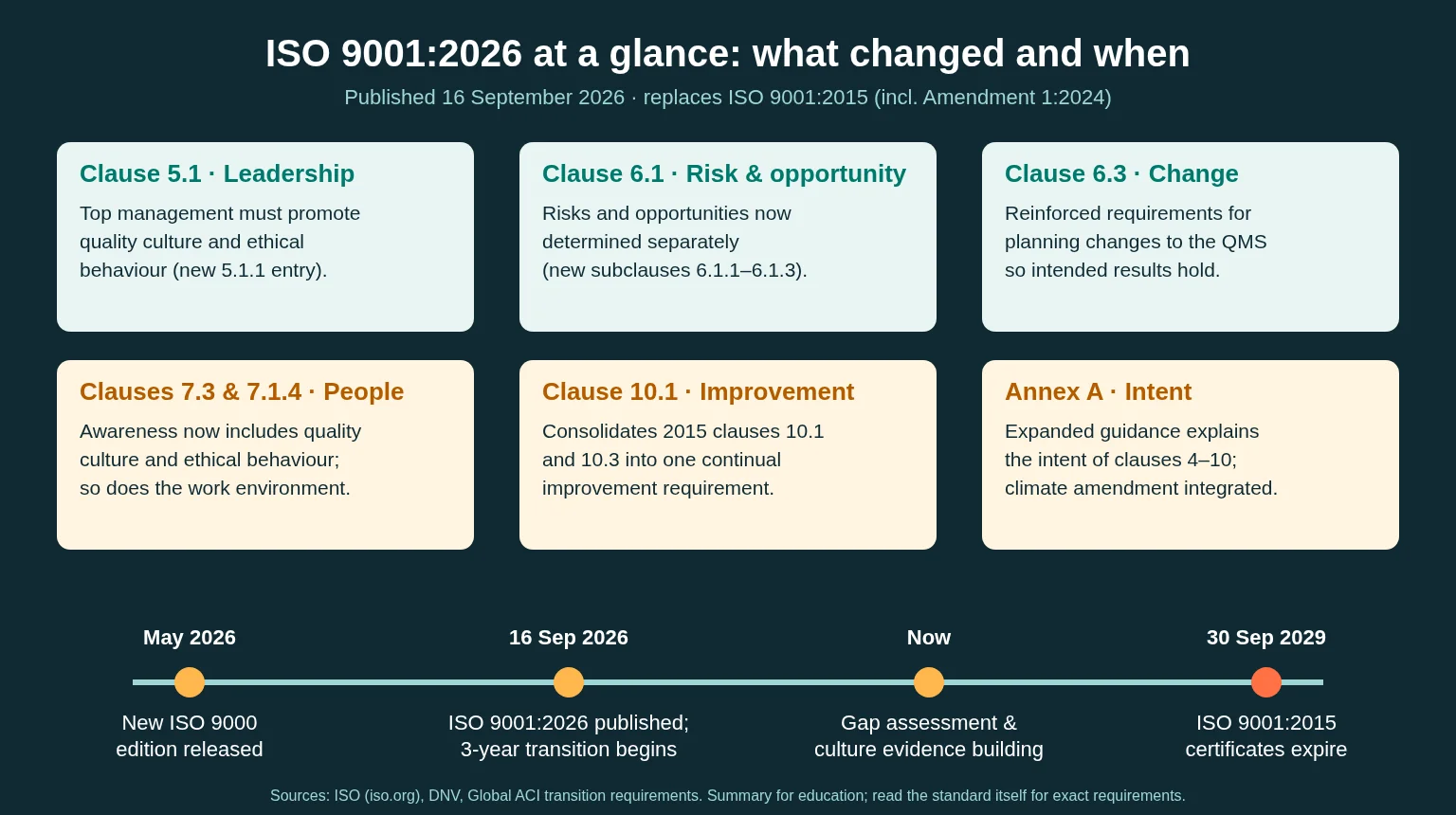
Before you launch a transition project, get clear on scope. Based on ISO's own summary and DNV's transition notes, the headline changes are:
| Clause | What changed | What it means on the floor |
|---|---|---|
| 5.1.1 Leadership | Promoting quality culture and ethical behaviour is added to leadership commitment. | Leaders need visible, repeatable behaviors, not just a signed policy. |
| 5.2 Quality policy | More explicitly linked to context and strategic direction. | Quality objectives should show up in the same review as cost and delivery. |
| 6.1 Risks and opportunities | Separated into subclauses 6.1.1 to 6.1.3, with more guidance in Annex A. | Stop using one FMEA-style register for everything; opportunities need their own owners. |
| 6.3 Planning of changes | Reinforced so changes to the QMS still achieve intended results. | Management of change becomes a stronger audit trail. |
| 7.3 Awareness / 7.1.4 Environment | Quality culture and ethical behaviour are referenced. | People should be able to say what "good" looks like and how to raise a concern safely. |
| 10.1 Continual improvement | Consolidates the 2015 clauses 10.1 and 10.3. | Your Kaizen system is the obvious evidence; make it traceable. |
The climate-change wording from the 2024 amendment is now built into Clauses 4.1 and 4.2, and the standard adopts ISO's latest Harmonized Structure. The clock matters too: Global ACI has set a three-year transition, and ISO 9001:2015 certificates stop being valid after 30 September 2029. That sounds like a long time. Culture change takes about that long.
The real cost of treating this as paperwork
If you handle the culture clauses as a documentation exercise, you pay twice. First, you pay for the transition project itself: consultants, policy rewrites, retraining on documents nobody reads. Second, and more expensive, you miss the one part of this revision that could actually move your numbers.
The problems that hurt most in a plant rarely come from a missing procedure. They come from the operator who saw the drift and didn't say anything, the supervisor who signed off a deviation to make the shipment, and the engineer who knew the gauge was suspect but had no time to raise it. Those are culture failures, and they show up as escapes, rework, and customer complaints. The new clauses give quality leaders a formal reason to work on them. Using that reason only to produce paper wastes the chance.
Operationalizing the shift: 4 ways to make culture auditable

The good news is that Lean already gives us the tools. Culture becomes auditable when it leaves a trail of behavior. Here is how to build that trail:
- Leader Standard Work with a Gemba component: Put scheduled floor time for every leader, from supervisor to plant manager, in writing. Record what they observed and what they followed up on. An auditor asking about Clause 5.1.1 should get a list of real conversations, not a mission statement.
- Problem-raising metrics, not just defect metrics: Track how many problems were raised at tier huddles, how fast they were acknowledged, and how many closed. A rising count of raised problems with falling escapes is a healthy culture. A count near zero is a warning sign, not a success.
- A protected stop-and-escalate path: Make sure anyone can stop or flag work for a quality concern without penalty, and document what happened afterward. Ethical behaviour (Clauses 5.1.1 and 7.3) is tested when a quality call collides with a delivery promise. Record those moments and the decisions made.
- Link Kaizen to the new 10.1: Your improvement events, A3s, and suggestion system are direct evidence of continual improvement. Tag each one to the process, risk, or opportunity it addresses so the line from Clause 6.1 to Clause 10.1 is visible.
Practical takeaways for this week's Gemba walk
Don't open a transition project on Monday. Start by finding out what your culture looks like today. On your next walk, try these three things:
- Ask the awareness question directly: Ask three operators, "If you saw something wrong with quality here, what would you do, and what would happen next?" Write down the answers word for word. That is your Clause 7.3 baseline.
- Find the last line stop: Ask when someone last stopped or held work for a quality reason and what leadership did about it. If nobody remembers one, find out why.
- Run a 30-minute gap check: With your management rep, walk Clauses 5.1.1, 6.1, 6.3, 7.3, and 10.1 against evidence you already have: huddle boards, Kaizen logs, MOC records. Mark each green, yellow, or red. The reds are your transition plan.
The next challenge is separating risk from opportunity
Culture is the headline, but the split in Clause 6.1 will change daily work more than most people expect. Many organizations have treated "risks and opportunities" as one register where opportunities show up as an afterthought. The 2026 edition separates them. In our next discussion, we will look at how to run an opportunity pipeline with the same discipline you use for an FMEA, so improvement is planned, not just reacted to.
Next Issue Preview
Next up: Risk is not opportunity. ISO 9001:2026 splits Clause 6.1 in two, and we look at why most risk registers bury improvement opportunities and how to run an opportunity pipeline with real owners and dates. Stay tuned.
Call to Action
Has your organization started its ISO 9001:2026 gap assessment? Tell me how you plan to show evidence of quality culture, and what your auditor has asked so far. P.S. Don't forget to share this with another leader who needs an honest diagnosis.
Newsletter replies and questions: [email protected]
Follow updates on X.com: @kaizen_6sigma
References
- ISO, "ISO launches update to world's most widely used quality management standard for a new era of business" (16 September 2026)
- ISO, "ISO 9001:2026: What businesses need to know"
- DNV, "Revision of ISO 9001 – Quality Management System"
- Global ACI, "Global ACI Publishes Transition Requirements for ISO 9001:2026" (16 September 2026)
- W. Edwards Deming, Out of the Crisis (MIT Press, 1986), 14 Points for Management, Point 10