
The Problem: Reviews that end with "noted"

In our last ISO 9001:2026 issue we built a change trail: every QMS change gets a measure and a dated review. Those reviews produce results, and results need somewhere to land. In most quality systems, that place is management review. It is also where a lot of good data goes to die.
You know the format. Once a year, every department presents. Quality shows the complaint chart, operations shows OEE, purchasing shows supplier scores, HR shows training completion. The meeting runs long, the last three presenters rush, and the minutes record each item as "reviewed" or "noted." Two actions come out of it, both owned by "the team," and nobody can say a year later whether they happened.
ISO 9001:2026 tightens Clause 9.3 in ways that make this format harder to defend. According to the Global ACI transition requirements, Clause 9.3.2 replaces "shall be planned and carried out taking into consideration" with "shall include," adds a new input on changes in the needs and expectations of interested parties, and reorganizes the remaining inputs. The review is no longer a meeting that should think about these things. It is a meeting that has to contain them.
Naming the failure: The Slide Marathon
We call this The Slide Marathon. It happens when management review is organized around reporting instead of deciding. Success is measured by how many charts were shown and whether everyone got their turn. The output is a record that information was presented, not a record of what top management chose to do about it.
The giveaway is the minutes. Count the verbs. If most items say "noted," "reviewed," or "discussed," and few say "approved," "funded," "stopped," or "assigned to a named person by a date," the meeting was a status report with a better room.
Lean people will recognize the pattern. It is a Check step with no Act. Hoshin Kanri, catchball, and A3 thinking all assume that a review ends in a choice. Management review is the QMS version of that moment, and ISO 9001:2026 is pushing it back toward the choice.
What Clause 9.3 looks like now
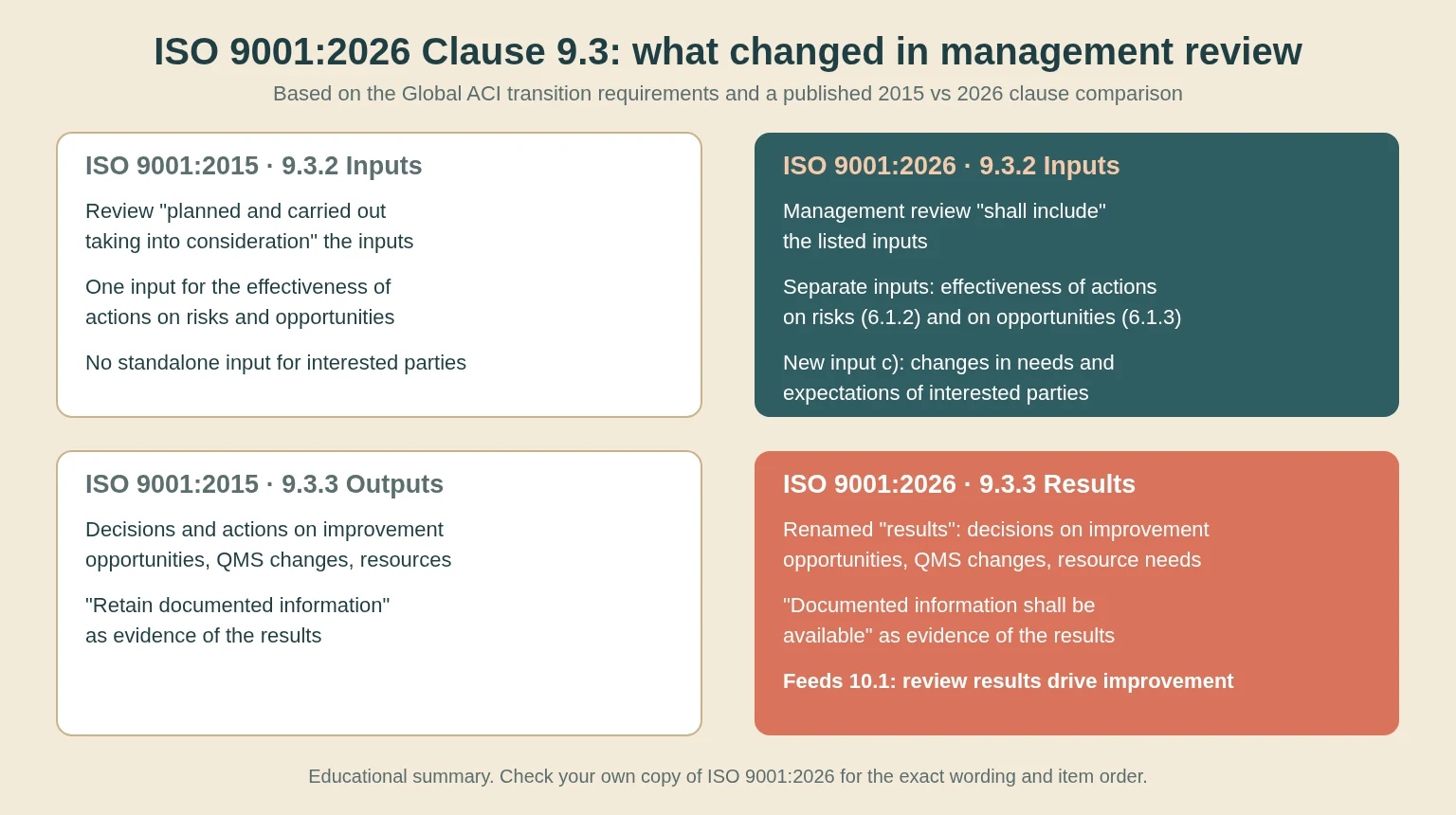
Based on the Global ACI transition requirements and a published side-by-side comparison of the 2015 and 2026 texts, these are the changes that matter at the review table:
| Item | What changed in 2026 | What it means at the table |
|---|---|---|
| Wording of 9.3.2 | "Taking into consideration" becomes "shall include" | Every listed input is on the agenda every time, and the record shows it. |
| Interested parties | New input on changes in their needs and expectations | A standing item tied to your Clause 4.2 register, even when the answer is "no change." |
| Risks and opportunities | Effectiveness of actions on risks (6.1.2) and on opportunities (6.1.3) listed separately | Two short reports, not one blended slide. Follows the Clause 6.1 split we covered earlier in this series. |
| 9.3.3 heading | "Outputs" becomes "results" | Decisions on improvement opportunities, QMS changes, and resource needs. |
| Evidence | "Retain documented information" becomes "documented information shall be available" | Minutes and action logs still matter. Make them easy to find. |
| Link to improvement | Continual improvement moves to 10.1, at the front of Clause 10, and still draws on management review results to find opportunities | Review decisions should show up in your improvement pipeline. |
Two cautions. First, the comparison we used shows Clause 9.3.1 (review at planned intervals, aligned with strategic direction) unchanged, so the standard still does not dictate one annual meeting. Many organizations cover the inputs across a cadence of shorter reviews. If you do, check with your certification body how they expect to see that every input was covered. Second, summaries differ slightly on item letters and order, so confirm the exact wording against your own copy of the standard before you rewrite your procedure.
The real cost of a review that decides nothing
The Slide Marathon costs you in three places. First, audit exposure. When inputs only had to be considered, a thin agenda was a judgment call. When the review "shall include" them, an auditor can lay the list beside your minutes and look for gaps. The new interested-parties input is the one most likely to be missing.
Second, priorities stall. Kaizen events, capital requests, and staffing gaps all wait for someone with authority to say yes or no. If management review only notes them, they roll to next year, and the people who raised them learn that raising things does not help.
Third, you lose the signal. A customer tightening a specification, a regulator signaling a new rule, or a key supplier struggling can all be early warnings. If nobody owns bringing those changes into the room, the organization hears about them as a complaint, a finding, or a late shipment.
Operationalizing the shift: 4 ways to run a review that decides

You already have the Lean tools for this. The job is to point them at the review itself:
- Build a fixed agenda from the clause: Turn every Clause 9.3.2 input into a named agenda item with an owner. Each owner sends a one-page pre-read: the trend, what it means, and the decision they need. Swap ten slides of history for one chart and one ask. The meeting time goes to the asks, not the reading.
- End every item with a decision type: Give the chair a short menu: approve, fund, assign, escalate, stop, or no action needed. Record which one was chosen, by whom, and with what owner and date. "No action needed" is a legitimate decision when the reason is written down. "Noted" on its own is not.
- Give interested parties a standing slot: Tie the new input to your Clause 4.2 register. One person reports what changed for customers, regulators, owners, employees, and key suppliers since the last review, and the minutes record the answer even when it is "no change." Changes that matter become inputs to risk, opportunity, or change planning.
- Open the next review with the last one: Status of actions from previous reviews is still the first input. Run it from a visible action log, not memory. Bring in results from the dated change reviews in Clause 6.3, and feed every approved improvement into the same pipeline your Kaizen and project work already uses, so Clause 10.1 has something to show.
Practical takeaways for this week's Gemba walk
You do not need to wait for the next scheduled review to start. On your next walk, try these three things:
- Count the verbs: Pull the minutes from your last management review. Count items that ended in a decision with an owner and a date, and items that ended in "noted" or "discussed." That ratio is your baseline.
- Trace one action to the floor: Pick one action from those minutes and go see it. Is it done, in progress, or forgotten? Ask the person doing the work whether they know it came from management review.
- Ask about interested parties: Ask one supervisor and one buyer what has changed recently for their customers or suppliers. If they name something that never reached the review, you have found your first item for the new standing slot.
The next challenge is improvement that leads the clause
Once management review produces decisions, they need a home. In ISO 9001:2026, continual improvement moves to the front of Clause 10 as 10.1, and its text now points to the results of monitoring, analysis, evaluation, and management review as the places to find opportunities. In our next discussion, we will look at what that reordering means for how you run Kaizen, projects, and corrective action as one system.
Next Issue Preview
Next up: Clause 10 and continual improvement as the first word, not the last. We look at how to connect management review results, Kaizen events, and corrective action into one improvement pipeline that auditors and operators can both follow. Stay tuned.
Call to Action
Open your last management review minutes. How many items ended in a decision with a name and a date? Tell me your ratio and the one change you will make to your next review. P.S. Share this with whoever builds your management review agenda before the next one is scheduled.
Newsletter replies and questions: [email protected]
Follow updates on X.com: @kaizen_6sigma