
The Problem: Four lists and no system
Last issue we turned management review into a meeting that ends with decisions, owners, and dates. Those decisions need somewhere to go. In most plants, they scatter.
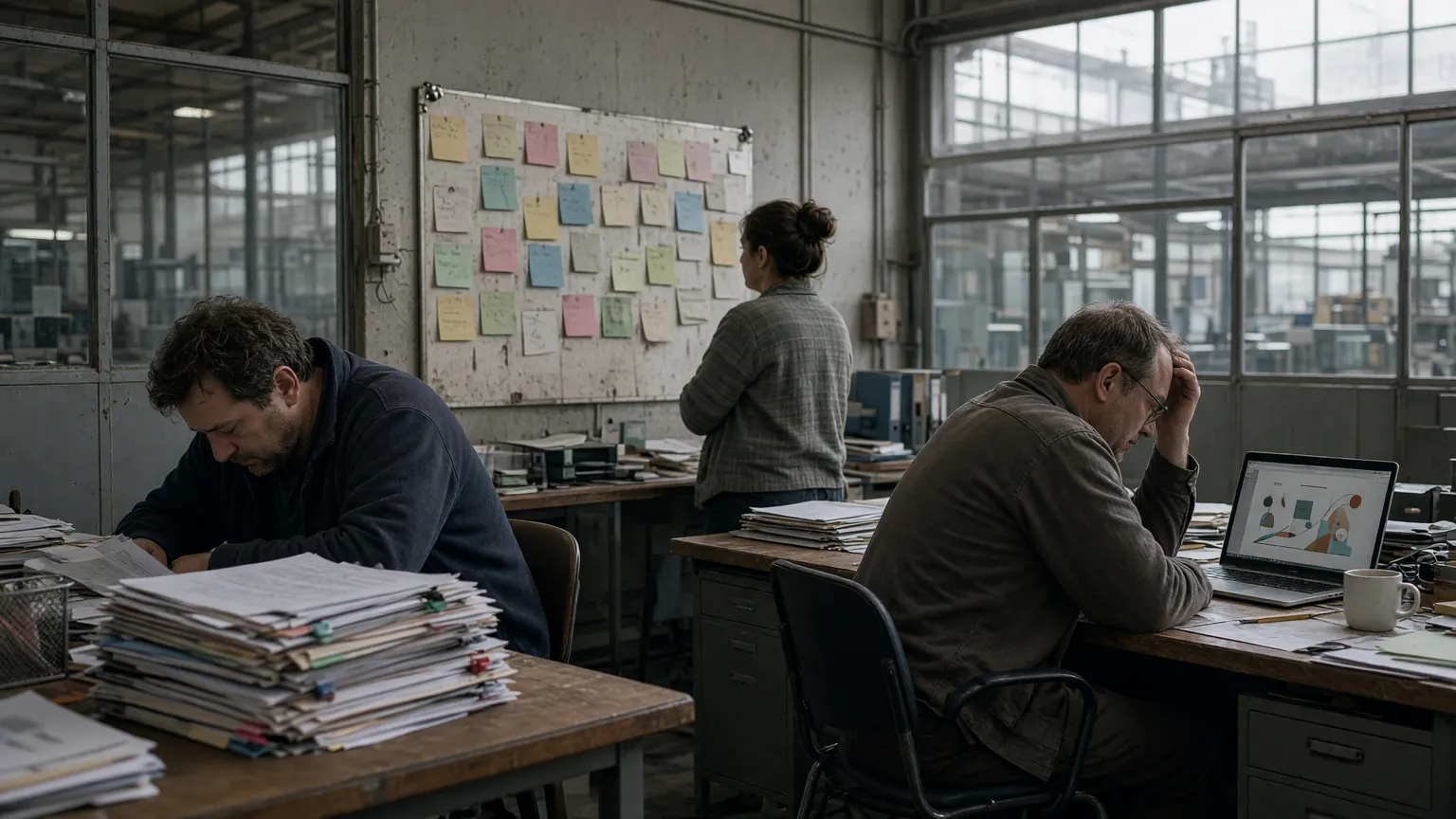
Walk around and count the places improvement work lives. There is the CAPA log the quality team owns. There is a wall of sticky notes left over from the last Kaizen event. There is a project tracker for the Green Belt and Black Belt work. There is a spreadsheet of management review actions, and maybe an idea box that nobody has opened since spring. Each list has its own owner, its own format, and its own definition of done. None of them can tell you what the organization is improving right now, or why those items beat everything else.
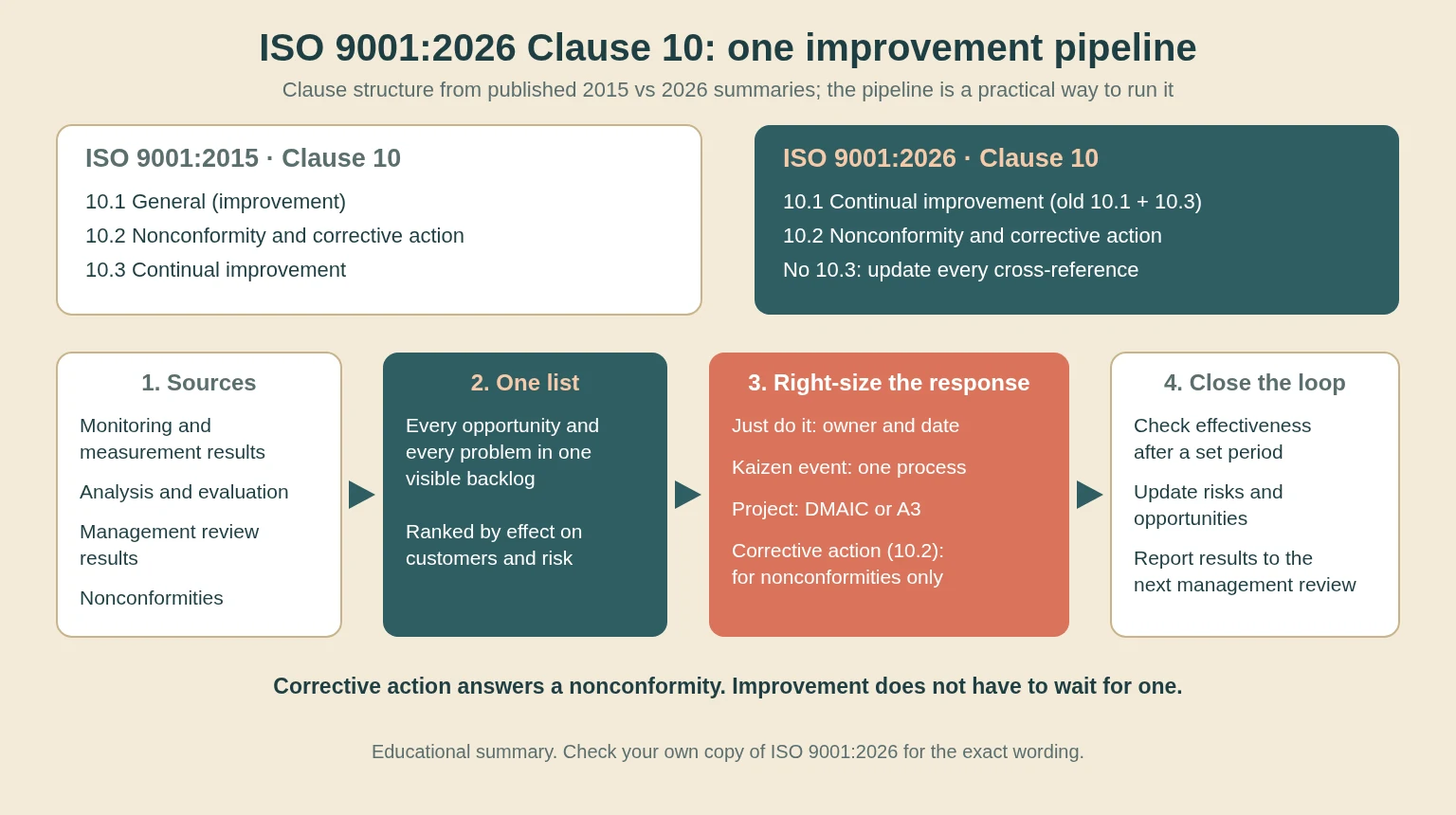
ISO 9001:2026 gives you a good reason to fix that. According to DNV and a clause-by-clause check of the published text by Qlause, Clause 10 now has two parts instead of three. The 2015 Clause 10.1 (improvement, general) and Clause 10.3 (continual improvement) are folded into a single Clause 10.1 titled "Continual improvement." Clause 10.2, nonconformity and corrective action, stays. There is no 10.3.
Naming the failure: CAPA as the Only Door
We call this CAPA as the Only Door. It happens when the corrective action system becomes the one formal way to get anything improved. A supervisor wants a fixture changed, so she writes it up as a nonconformity. A planner wants a better changeover sequence, so it becomes a "preventive CAPA." The CAPA log swells, every item gets the same eight-step treatment, and real nonconformities wait in line behind good ideas dressed up as problems.
The opposite failure is just as common. Kaizen events and projects run on their own track, never touch the CAPA log, and nobody checks whether the problem a team fixed in March is the same one quality is still investigating in October.
The guidance in 9001 Simplified puts the line clearly: corrective action under Clause 10.2 responds to a nonconformity, and it should not be used as a catch-all label for every improvement. Proactive improvement can come from risk and opportunity planning under Clause 6 and from continual improvement under Clause 10.1. Two doors, one building.
What Clause 10 looks like now
Based on DNV's summary of the revision and published clause guidance from Qlause, 9001 Simplified, and Sterling GRC, these are the points that matter for how you run improvement:
| Item | What changed in 2026 | What it means on the floor |
|---|---|---|
| Structure | Old 10.1 and 10.3 merge into 10.1 Continual improvement; 10.2 stays; no 10.3 | Improvement is the first requirement in Clause 10, not the last. Fix every manual, procedure, and audit checklist that cites 10.3. |
| Where opportunities come from | Results of monitoring, measurement, analysis, evaluation, and management review | The decisions from your last review and the trends in your KPIs should feed the same list. |
| What actions cover | Improving processes, products, and services; addressing future needs and expectations; correcting, preventing, or reducing undesired effects | Kaizen events, projects, and fixes all count. Not everything has to start as a problem. |
| Annex A guidance | DNV notes new guidance that improvement can come from changes in context, risks, opportunities, and the adoption of technologies | A new sensor, a data system, or an automation project belongs in the improvement conversation, not only in IT. |
| Corrective action (10.2) | Still reacts to nonconformities, evaluates causes, checks whether similar problems exist elsewhere, and reviews effectiveness | Keep it for nonconformities and size the response to the effect of the problem. |
Two cautions. First, the published guidance stresses that the substance of continual improvement carries over from 2015. The renumbering is not a new burden, but it is a good moment to look at how your system actually works. Second, summaries differ slightly in wording, so confirm the exact text against your own copy of ISO 9001:2026 before you rewrite your procedure.
The real cost of scattered improvement
Scattered improvement costs you in three places. First, capacity. The same few engineers, supervisors, and quality people are pulled into CAPAs, Kaizen events, and projects from separate lists, and nobody can see the total load. Work stalls not because it is unimportant, but because it was never weighed against everything else.
Second, repeat problems. When a Kaizen team and a corrective action team work the same failure mode without knowing it, you get two fixes, two sets of paperwork, and no single check on whether the problem is gone. Sterling GRC's guidance makes the point that completing a form or a training session does not make a corrective action effective. That is just as true of a Kaizen event that ends with a report-out and no follow-up measure.
Third, credibility. When people raise ideas and never see where they went, they stop raising them. A single visible list, with a status on every item, is the cheapest engagement tool you have.
Operationalizing the shift: 4 ways to build one pipeline

You already have the Lean tools. The job is to connect them:
- Make one visible list: Pull every open item from the CAPA log, the Kaizen parking lot, the project tracker, and the management review action log into one backlog. Tag each with its source. You will find duplicates on day one, and that is the point.
- Rank it once, in one place: Score each item by its effect on customers and its risk. For opportunities, reuse the benefit and feasibility scoring from our Clause 6.1 issue. Pick a manageable number to work. Everything else waits visibly, with a reason, instead of quietly.
- Right-size the response: Give each item a lane. A just-do-it fix gets an owner and a date. A single-process problem gets a Kaizen event. A cross-functional or data-heavy problem gets a DMAIC project or an A3. A nonconformity goes through Clause 10.2 corrective action, with depth matched to its effect. The lane changes the method, not the list.
- Close every item the same way: Before anything leaves the board, define what better looks like, measure it after a set period, update the risk and opportunity register if the learning changes it, and report the result to the next management review. That is the loop from Clause 9.3 back into Clause 10.1, and it is the evidence an auditor will look for.
Practical takeaways for this week's Gemba walk
You do not need a new software system to start. On your next walk, try these three things:
- Count the lists: Ask a supervisor, a quality engineer, and a CI lead where improvement work is tracked. Write down every list they name. The number is your baseline.
- Find one duplicate: Pick the top recurring defect on one line and search every list for it. If it shows up in more than one place with different owners, you have your first merge.
- Ask the operator: Ask one operator what happened to the last idea they raised. If they do not know, the list is not visible enough yet.
The next challenge is corrective action that actually works
Once improvement runs through one pipeline, the nonconformities lane deserves a hard look. Clause 10.2 still asks you to evaluate causes, check whether similar problems exist or could occur elsewhere, and review whether the action worked. In practice, too many CAPAs close on "human error" and "operator retrained." In our next discussion, we will look at what effective corrective action looks like under the 2026 text.
Next Issue Preview
Next up: Clause 10.2 and the end of "operator retrained." We look at how to separate correction from corrective action, how to get past human error as a root cause, and how to prove a corrective action worked before you close it. Stay tuned.
Call to Action
Count the places improvement work is tracked in your organization today. Is it one list or four? Tell me your number and the first thing you would merge. P.S. Share this with whoever owns your CAPA system and whoever runs your Kaizen events, ideally in the same email.
Newsletter replies and questions: [email protected]
Follow updates on X.com: @kaizen_6sigma