
The Problem: The paperwork says the plant can take the cold. The last storms said otherwise.
On November 18, NERC published its 2026–2027 Winter Reliability Assessment. Much of it is good news. Resource additions, delayed retirements, and better generator performance in cold weather have improved the outlook, and every assessment area has enough resources for a normal winter peak. NERC still warns that extreme, wide-area cold could cause supply shortfalls. It also notes that the overlapping arctic air masses of January 2026 showed planners should prepare for extreme conditions lasting 10 days or more. Its recommendation to generator owners is plain: complete winter readiness plans and checklists before December.
On paper, the fleet looks ready. In NERC's October 1, 2026 cold weather data filing, 99% of total net winter capacity in the continental U.S. said it could operate at its calculated Extreme Cold Weather Temperature.
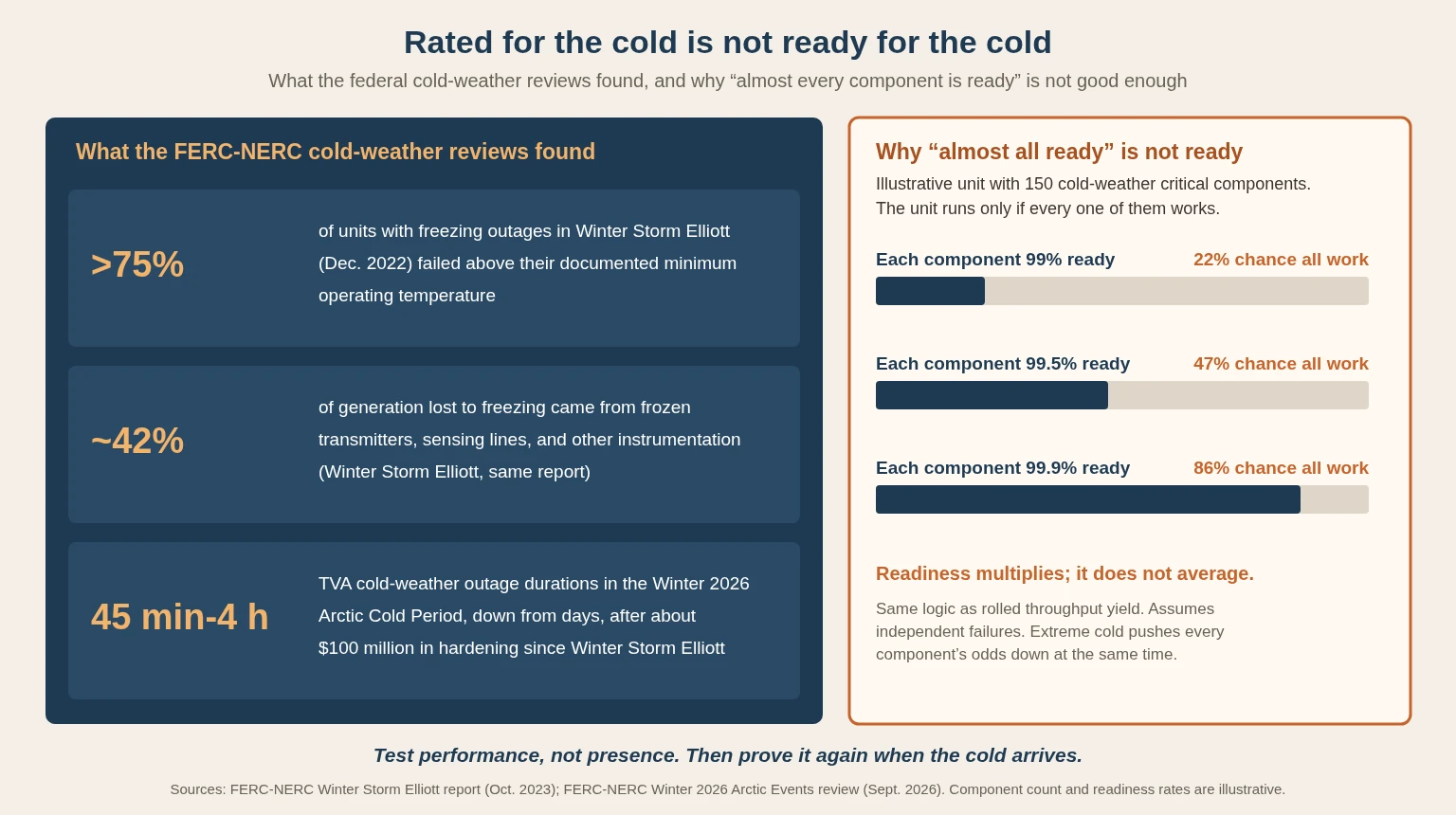
The history says to be careful with that number. In the joint FERC-NERC report on Winter Storm Elliott (December 2022), more than 75 percent of the generating units that had unplanned outages from freezing failed above their own documented minimum operating temperatures. Frozen transmitters, frozen sensing lines, and other frozen instrumentation caused about 42 percent of all generation lost to freezing. The report noted that these were the same types of freezing problems seen during Winter Storm Uri in 2021.
An older NERC lesson learned, published in October 2011, shows how it happens. Ahead of a forecast cold snap, staff at a combined cycle plant designed for a minimum ambient temperature of 4°F held meetings, called in extra people, verified that all heat trace equipment was functioning, and made sure insulation was in place. Then single-digit temperatures and steady wind froze drum level, combustor pressure, and feedwater pump sensing lines. Units tripped or failed to start, and the loss contributed to load shedding. One of its lessons applies to every site: heat trace modified with parallel circuits can pass a continuity test while one or more legs, hidden under insulation, have failed.
That plant did the checklist. It just did not prove the result.
Naming the failure: the Rated-Cold Gap
We call it the Rated-Cold Gap: the distance between the temperature on the design sheet and the temperature at which the plant actually stops. The design rating describes the equipment as it was built. The gap is made of everything that happened since: heat trace that has aged, insulation removed for a repair and put back loosely (or not at all), a new transmitter added without tracing, wind that nobody designed for, and a readiness check that confirms something is switched on rather than that it delivers heat where the pipe needs it.
This is not only a power plant problem. Any site with outdoor instrument lines, compressed air, water lines, or fire protection piping has a Rated-Cold Gap. The power sector simply has the best published data on it, because FERC, NERC, and the Regional Entities have reviewed the major cold weather events since 2011.
The timing matters. NERC wants checklists done before December, and Thanksgiving week is next week. The assessment also warns that natural gas purchase deadlines come before long holiday weekends, so a cold forecast over a holiday weekend affects fuel planning too. A readiness gap found in the first week of December can still be fixed. One found during the first arctic blast cannot.
Why this is a reliability problem, not a checklist problem
A winter checklist with a check mark beside every line feels like readiness. Three reliability ideas explain why it often is not:
- Readiness multiplies. A unit runs only if every cold weather critical component works at the same time. That is the logic of rolled throughput yield: the chances multiply, they do not average. In the illustrative example in the chart, a unit with 150 critical components that are each 99% ready has only about a 22% chance that all of them work. At 99.5% it is about 47%. At 99.9% it is about 86%. The example assumes independent failures and is there to show the scale, not to predict any unit. Extreme cold makes it worse, because it pushes every component's odds down at once. You can try your own numbers in the rolled throughput yield calculator.
- Freeze protection is a hidden failure. In reliability-centered maintenance terms, a failed heat trace leg or a gap in insulation stays invisible during normal operation. It only shows up when the cold arrives, which is the worst time to find it. Hidden failures need failure-finding tasks, meaning a test that proves the protection works. A visual check that a breaker is closed is not such a test.
- The fix is a learning loop, not a bigger binder. The Winter 2026 review shows what good looks like. After Winter Storm Elliott, TVA invested about $100 million in sturdier protection and physical hardening. During the January 2026 cold, its cold-weather generator outages lasted about 45 minutes to four hours rather than days. The outages it did have came from instrumentation, valve skids, and airline valve controls, and TVA added those components to its cold-weather critical component list. That is a corrective action loop doing its job: each event updates the standard. The same review notes that NYISO inspected generator sites in the fall of 2025 to verify weatherization, and that TVA tested its dual-fuel units that fall to confirm they could run on their alternate fuel.
NERC's cold weather standard, EOP-012-3, already requires generator owners to keep cold weather preparedness plans that identify cold weather critical components, document freeze protection, and include annual inspection and maintenance of those measures. It also requires annual training for the maintenance and operations staff who carry out the plan. The standard sets the minimum. Whether the plan works depends on how the inspection is done.
How to close the Rated-Cold Gap before the first arctic blast

You do not need a new program. You need to turn the checklist you already have into proof:
- Build the critical list from failure history, not the design drawing: Pull every freeze-related trip, derate, failed start, and near miss from the last several winters, including the ones operators fixed with a tarp and a space heater and never logged. Put them in a Pareto chart by component type. Instrument sensing lines, transmitters, small valves, and air lines will often sit near the top. Anything that froze or nearly froze goes on the critical component list.
- Test performance, not presence: For each critical heat trace circuit, measure what it delivers. Compare current draw with the design value, check each leg of parallel circuits, and confirm the pipe surface temperature with a contact thermometer or thermal camera. Record the reading, not just a check mark. A reading can be trended next year; a check mark cannot.
- Mistake-proof the things people forget: Add mistake-proofing where a person would otherwise have to remember. Examples include heat trace failure alarms or status lights visible from the walkway, and a work-order close-out step that the job is not complete until insulation and tracing are restored and inspected. The 2011 lesson learned calls out exactly this: after maintenance, check that insulation meets the original specification and was correctly reinstalled.
- Put cold checks into operator rounds: Make freeze protection part of autonomous maintenance. Give operators a short route of the highest-risk points, and use the forecast to set how often they walk it, for example more often as temperatures and wind chill drop. A one-page one-point lesson at each critical rack works better than a slide deck. Hold the annual cold weather training at the equipment, not only in a classroom.
- Rehearse the backup mode before you need it: Test alternate fuel, standby heaters, and portable weatherization kits in November, the way TVA tested its dual-fuel units in the fall. Stage tarps, heaters, and wind breaks near the components that froze before. Confirm holiday staffing and, for gas-fired units, fuel procurement before the Thanksgiving weekend.
- Close the loop after every cold event: Treat each freeze trip as a defect. Run a 5 Whys to the physical cause (failed leg, missing insulation, wind exposure, design gap), update the critical component list and the inspection standard, and share the finding across sites with similar equipment. That is how TVA turned instrumentation and valve-skid outages into list items instead of repeat events.
If you run a plant outside the power sector, the same six steps work. Replace "unit trip" with whatever stops your line, such as a frozen air line to a valve actuator, a frozen level transmitter on a tank, or a fire water line that bursts.
Practical takeaways for this week's Gemba walk
Spend an hour outside, at the pipe rack, not in the conference room:
- Follow one circuit from breaker to pipe: Pick one critical transmitter and trace its heat trace from the panel to the sensing line. Ask to see the last current reading and the last surface temperature. If the record is only a check mark, you have found your first improvement.
- Look for the insulation that came off this year: Ask maintenance which jobs since spring removed insulation or tracing on critical lines, and then go look at three of them. Check for cuts, gaps, loose jacketing, and bare valve bodies.
- Ask an operator, "Which line froze last winter, and what did you do?": Then check whether that component is on the critical list and whether the fix became standard work, or was just a tarp that came down in March.
Winter is a test you do not get to schedule
The federal reviews tell a hopeful story. Freeze protection, early commitments, and the cold weather standards have measurably improved how the grid handles extreme cold since Uri and Elliott. They also show that a design rating and a completed checklist are not the same as a plant that runs at the design temperature. Close the Rated-Cold Gap the way you would close any quality gap: find the critical few from failure data, measure the outcome rather than the activity, mistake-proof the steps people forget, and feed every event back into the standard. Do it in November, while you still have time to act on what you find.
Educational use only: this issue is written from a quality and operations perspective, not as engineering, safety, or regulatory compliance advice. Event details are summarized from the cited FERC, NERC, and Regional Entity reports; read the originals and your applicable standards, and have qualified engineers review any change to freeze protection or plant equipment. The component example is illustrative.
Next Issue Preview
Next time we pick another corner of the improvement toolbox, chosen from what is happening on real floors this month. Stay tuned.
Call to Action
Before December 1, pick the ten components on your site most likely to freeze, and for each one write down the last measured proof that its protection works: a current reading, a surface temperature, or a test date. Where the answer is only a check mark, schedule the test this week. Send me what you found, anonymized. P.S. Share this with your plant manager, your I&E or electrical lead, and whoever owns the winter readiness checklist.
Newsletter replies and questions: [email protected]
Follow updates on X.com: @kaizen6sigma
References
- NERC, "Increasing Demand and El Niño Challenge Winter Grid Reliability" (news release, November 18, 2026)
- NERC, "2026–2027 Winter Reliability Assessment" (November 2026)
- FERC, NERC and Regional Entity Staff, "Inquiry into Bulk-Power System Operations During December 2022 Winter Storm Elliott" (October 2023)
- FERC, NERC and Regional Entity Staff, "Winter 2026 Arctic Events: A System Performance Review" (September 10, 2026)
- NERC, Lesson Learned: "Plant Instrument and Sensing Equipment Freezing Due to Heat Trace and Insulation Failures" (October 19, 2011)
- NERC, Reliability Standard EOP-012-3, "Extreme Cold Weather Preparedness and Operations"