
The Problem: Changes that end at the signature

Last issue we split risks from opportunities under ISO 9001:2026 Clause 6.1. Once opportunities have owners, they start turning into changes: a new fixture, a new inspection step, a reorganized cell, a new software module. That is where the next weak link shows up.
Most plants have a change form. Someone writes the purpose, someone checks the impact, a manager signs, and the change goes live. Then the form gets filed. Nobody decides in advance how the floor will be told, what number will prove the change worked, or when anyone will look again. Three weeks later the second shift is still running the old setup, and the change that was supposed to cut scrap has quietly become the reason for a new deviation.
ISO 9001:2026 closes that gap in Clause 6.3. DNV describes the revision as reinforcing management of changes to the QMS "with the aim to support achievement of intended results." ISO's foreword calls it strengthened management of change. The practical meaning is simple: a change is not finished when it is approved. It is finished when someone has checked that it worked.
Naming the failure: The Sign-Off Finish Line
We call this The Sign-Off Finish Line. It happens when the change process treats approval as the end of the race. Planning effort goes into justifying the change and getting signatures. Almost none goes into telling the people affected, measuring the result, or reviewing whether the change should stay.
Under ISO 9001:2015, a change process that stopped at approval could still satisfy Clause 6.3, because the clause asked you to consider purpose and consequences, QMS integrity, resources, and responsibilities. All four can be answered before go-live. Under ISO 9001:2026 they cannot be the whole story. The clause now begins "To ensure changes are implemented effectively to achieve intended results," and adds three considerations that only make sense after the change is made: communication, monitoring and evaluating effectiveness, and reviewing the results.
Lean people will recognize this immediately. It is PDCA with the Check and Act put back in. A change that skips them is not a Kaizen. It is a guess with a signature on it.
What Clause 6.3 looks like now
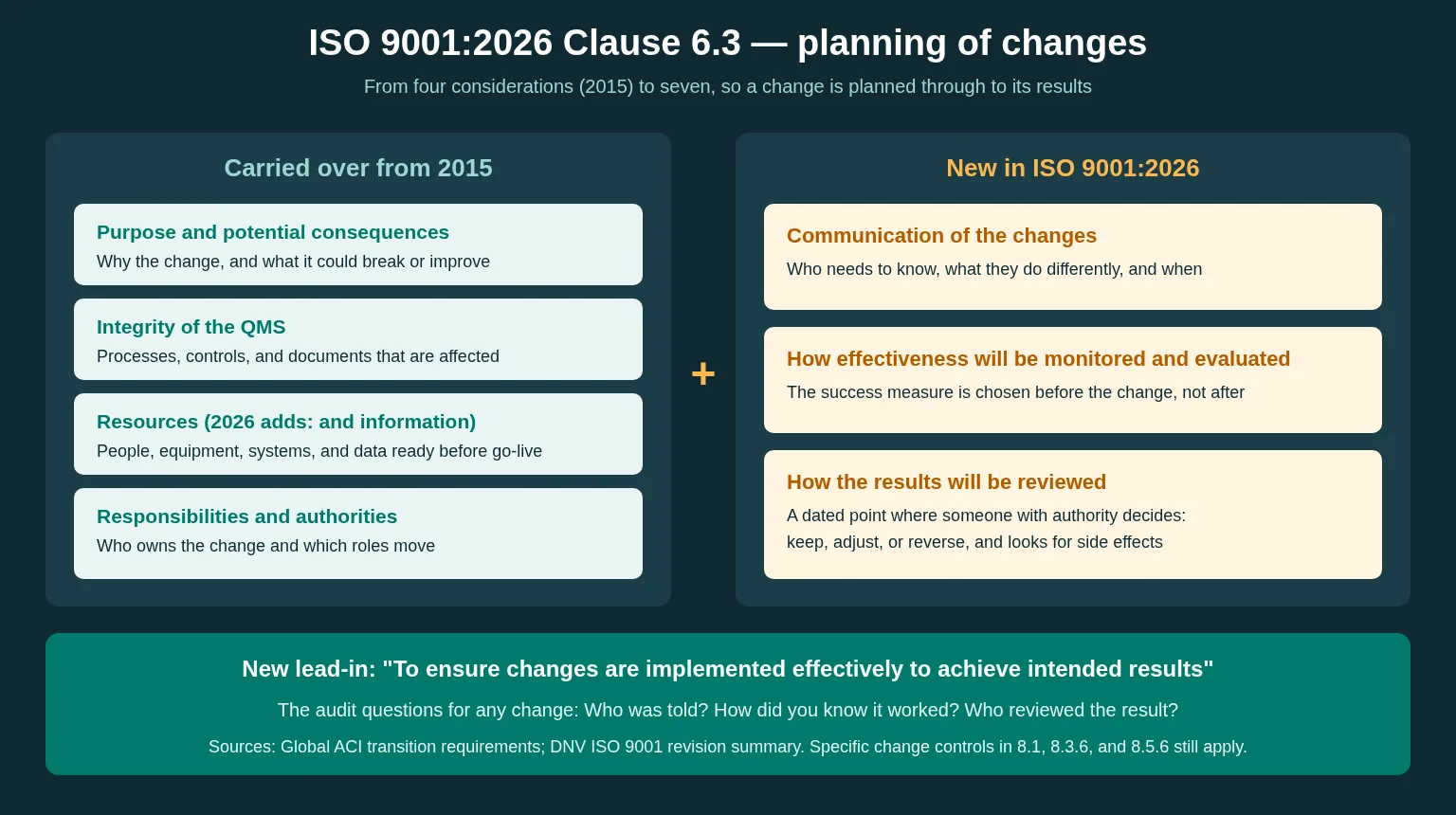
Based on the Global ACI transition requirements and published clause-by-clause summaries, Clause 6.3 now lists seven things to consider when you plan a change to the QMS:
| Consideration | Status in 2026 | What "done" looks like on the floor |
|---|---|---|
| Purpose of the change and its potential consequences | Carried over | One sentence on why, plus what could go wrong and what could improve. |
| Integrity of the QMS | Carried over | A list of affected processes, controls, documents, and records. |
| Availability of resources | Extended to include information | People, equipment, systems, and the data they need are ready before the start date. |
| Allocation of responsibilities and authorities | Carried over | A named change owner and any roles that move permanently. |
| Communication of the changes | New | Every affected shift, process owner, supplier, or customer knows what changes and what they now do differently. |
| How effectiveness will be monitored and evaluated | New | The success measure, who watches it, and for how long, decided before go-live. |
| How the results will be reviewed | New | A dated review where someone with authority decides to keep, adjust, or reverse. |
Two cautions. First, Clause 6.3 is about changes to the QMS. Operational change controls still live in Clause 8.1, design changes in 8.3.6, and production or service changes in 8.5.6, each with its own records. Clause 6.3 is the general method that sits above them, not a replacement. Second, the standard asks you to consider these items, not to build a thick procedure. Proportionality still matters: a new shift pattern does not need the same paperwork as a new site.
The real cost of stopping at approval
The Sign-Off Finish Line costs you in three places. First, audit time. An auditor can pick any recent change, from an ERP module to a new inspection frequency, and ask three questions most change files cannot answer: who was told, how did you know it worked, and who reviewed the result. If the answers live in someone's memory, that is a soft target.
Second, standard work drift. When communication is not planned, the change reaches the people in the meeting and nobody else. The work instruction gets updated, but the laminated copy at the station does not. The night shift learns about the change from a nonconformance.
Third, and most expensive, you lose the learning. A change with no measure and no review cannot tell you whether it helped. Do that enough times and the organization keeps changes that did nothing, reverses changes that were working, and argues about both from opinion instead of data. That is the opposite of continual improvement.
Operationalizing the shift: 4 ways to build a change trail

You already have the Lean tools for this. The job is to connect them into one trail an auditor can follow from decision to result:
- Make the change plan one page with seven boxes: Rework your change request form so each Clause 6.3 consideration has its own field. The three new boxes must be filled before approval, because they describe the future: how you will communicate, what you will measure, and when you will review. An empty box is a reason to send the form back, not a formality.
- Pick the measure from the purpose: If the change was meant to reduce changeover time, measure changeover time. If it was meant to cut release errors, count release errors. Record the baseline before go-live, name who checks it, and set how long you will watch. This is the same discipline as the Control phase in DMAIC, just applied to every QMS change.
- Plan communication by shift, not by meeting: List who needs to know, including other shifts, other process owners, suppliers, and customers where Clause 8.2.4 applies. Choose the route for each: tier huddle, toolbox talk, revised work instruction, or formal notification. Then verify at the Gemba that the station copy and the operator's understanding both changed.
- Put a dated review on the calendar at approval: Schedule a 30-, 60-, or 90-day check sized to the change. At that review, the owner shows the measure against baseline and asks for one decision: keep, adjust, or reverse. Look for unintended side effects as well as intended results. Significant outcomes become inputs to management review and, if the change worked, a candidate for Yokoten across other lines.
Practical takeaways for this week's Gemba walk
You do not need to rewrite your whole change procedure to start. On your next walk, try these three things:
- Pull three recent changes: Pick three QMS changes approved in the last six months. For each one, try to answer the three audit questions from records alone. Count how many you can answer. That count is your baseline.
- Check one station copy: Choose one of those changes and walk to the affected station. Compare the posted instruction with the approved version, and ask an operator on a different shift what changed. Write down what you find.
- Book one overdue review: For any of the three changes with no review, put a 30-minute review on the calendar with the owner and the measure. If no measure was ever defined, that is your first finding, and the fix is to choose one now.
The next challenge is management review that decides something
Once changes carry measures and review dates, their results have to go somewhere. Clause 9.3.2 in ISO 9001:2026 now says management review inputs "shall include" its listed items rather than being taken into consideration, and adds changes in the needs and expectations of interested parties. In our next discussion, we will look at how to turn management review from a slide marathon into a meeting that makes decisions on risk actions, opportunity actions, and change results.
Next Issue Preview
Next up: Clause 9.3 and the management review that actually decides. We look at the new mandatory inputs in ISO 9001:2026 and how to build a review pack that ends with owners, dates, and decisions instead of "noted." Stay tuned.
Call to Action
Pick your last approved change. Can you show who was told, how you knew it worked, and who reviewed the result? Tell me what your change form is missing and how your team closes the loop. P.S. Share this with whoever owns your change request form before the next internal audit.
Newsletter replies and questions: [email protected]
Follow updates on X.com: @kaizen_6sigma