The Gap Between the Headline and the Grind
When you see a headline like "$49 Billion in New Manufacturing Investment," it’s easy to let your mind drift toward high-level economic growth, job creation statistics, and regional prosperity. It sounds like a win. But for someone who spends their day on the shop floor—dealing with machine downtime, parts shortages, and the reality of a 10% first-pass yield—that number is not an operational plan.
The problem is what I call The Macro Mirage.
A headline is not a strategy. A press release about billions in investment is not a roadmap for your supply chain_ or a training manual for your operators. The "Macro Mirage" occurs when leadership treats these massive numbers as if they are ready-to-use resources, rather than just the beginning of a very long and difficult construction project.
To an executive in a glass office, $49 billion means growth. To a plant manager on the floor, that number represents a looming wave of demand that your current processes might not be able to handle without breaking. You can’t "scale" a broken process by simply adding more volume; you just end up with a bigger mess.
We have to distinguish between what an investment is and what it does. The money is the fuel, but your operational systems are the engine. If the engine has cracks in the block or worn-out gears—like inconsistent standard work, unreliable machine calibrations, or a lack of cross-trained operators—more fuel won't make you go faster; it will just cause the engine to overheat and fail sooner.
Anatomy of Scale: Where Does the Money Actually Go?
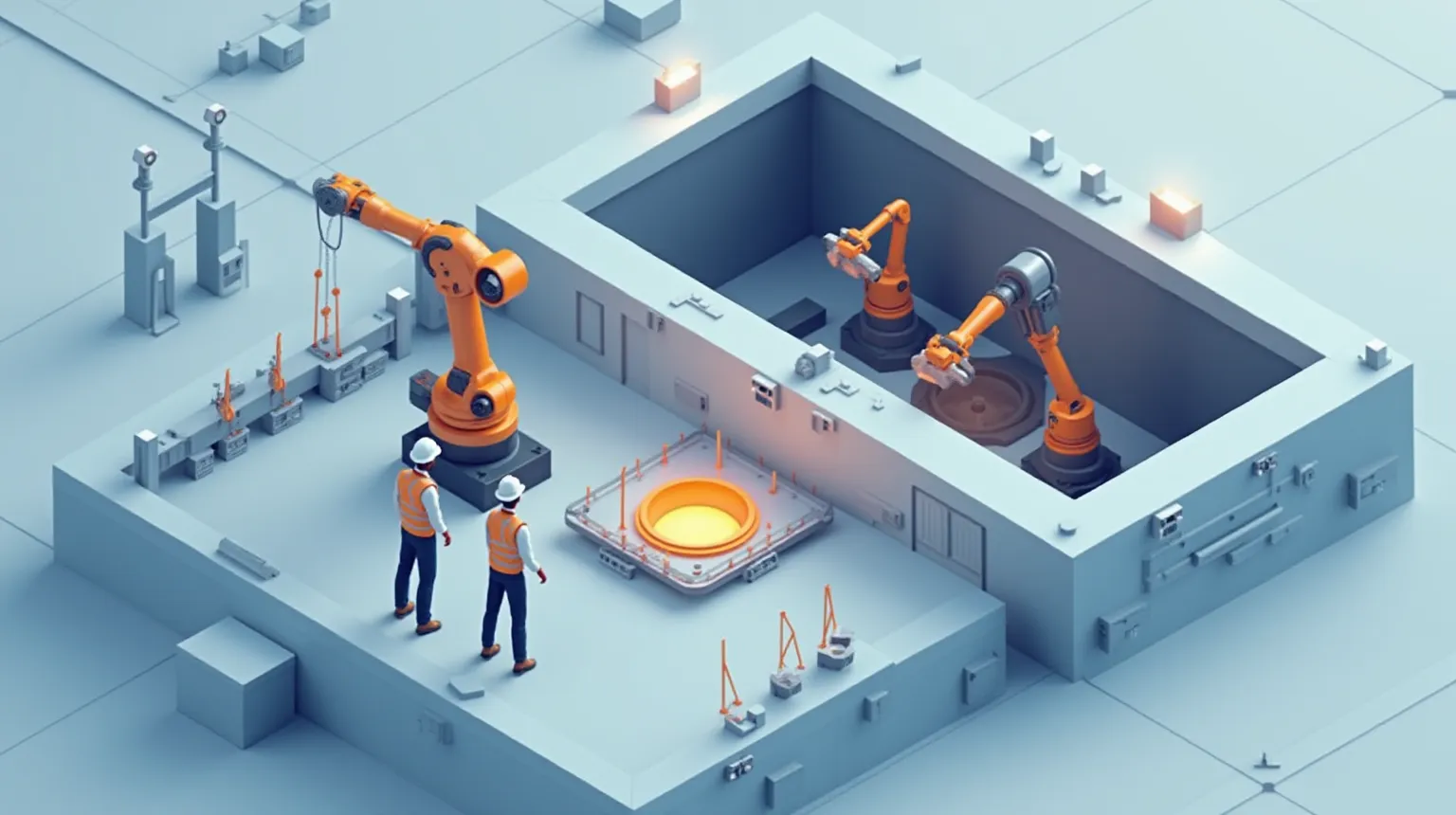
To understand how this affects your specific operation, we have to pull the curtain back on where that money actually lands in a manufacturing ecosystem. It isn’t all "profit" for everyone involved; it is spent very quickly on physical reality.
The $49 billion figure typically breaks down into three primary buckets:
- Hard Infrastructure: The literal ground, buildings, and utilities required to house the machines.
- Capital Equipment (CapEx): The CNC centers, robotic arms, specialized tooling, and automation systems that do the heavy lifting.
- Operational Integration: The "soft" but critical costs of hiring, training, supply chain stabilization, and local vendor integration.
When these investments hit your backyard, it changes the pressure on everyone in the local orbit. Your neighbors aren't just getting bigger; they are competing for the same finite resources you rely on every day: skilled machinists who can read a blueprint, high-quality raw materials, and reliable logistics partners.
| The Comfortable Rationalization | The Underlying Reality |
|---|---|
| "The investment means more customers will want our parts." | More demand puts immediate stress on your current supplier contracts and lead times. |
| "We can just hire more people to meet the new volume." | Finding a skilled operator who understands standard work is harder and slower than hiring a general laborer. |
| "Newer machines nearby mean better local technology." | Newer neighbors will outbid you for high-end components and specialized maintenance technicians. |
You cannot treat this as an abstract economic win. You have to look at your shop floor and ask: If my order volume tripled next month because of the neighboring expansion, where would the line stop? Which machine would seize up first? That is the only "scale" that matters for your daily operations.
The Hidden Cost of Growth Acceleration
When a region sees an influx of capital this large, it creates what I call The Friction of Velocity. When everyone tries to move faster at once, the systems designed to keep things running smoothly—your supply chain, your labor pool, and your local infrastructure—begin to fray.
There is a difference between "growth" and "sustainable expansion." Growth happens when you add volume; sustainability comes from having the processes in place to handle that volume without quality degradation.
The risks of rapid growth aren't just about being too busy. They are about:
- Supply Chain Snap: Your current vendors may not have the capacity to serve both your needs and those of a new, massive neighbor. You might find yourself at the back of the line for critical components.
- The Talent Drain: When big money moves in, it often brings "poach" tactics. They will target your best-trained leads and most experienced technicians with higher wages, leaving you to train newcomers while trying to maintain your current output.
- Quality Drift: Under the pressure of rapid expansion, there is a constant temptation to take shortcuts—skipping a calibration check, loosening a standard work step, or "making it work" for one shift just to hit a number.
This isn't about being pessimistic; it’s about identifying where the system will buckle. If your current process requires 10% manual intervention and you suddenly need to produce 50% more, that manual step becomes a bottleneck. You cannot "manage" a bottleneck by simply telling people to work harder; you have to eliminate the constraint or automate the task before it causes a failure on the line.
From Theory to Torque: The Three Pillars of Readiness
If we want to move from the headline to something tangible, we need to look at your operation through three specific lenses. These are not "initiatives" for next year; these are things you should evaluate during your next Gemba walk or leadership meeting this month.
1. Supply Chain Resilience
Don't assume your current suppliers can handle the local boom. You must audit your critical components now. Who provides your most specialized parts? Do they have a "growth" plan that includes your volume for the next three years? If not, you need to secure firm commitments or find secondary sources today. A "just-in-time" system fails when everyone else is also trying to be just-in-time during an expansion.
2. Labor Depth and Skill Mapping
Map out your floor's capabilities. How many of your operators can perform three different roles? If your best technician quits for a higher-paying job at the new facility next door, does the line stop? You need to build "redundancy" into your staffing—not just more people, but more capable people who are trained in standard work so that no single individual is a "single point of failure."
3. Process Integrity (The Standard Work Test)
Growth exposes every crack in your documentation. If your process relies on the "tribal knowledge" of an old-timer rather than a clear, written standard, it will fail under pressure. You must ensure that your control plans are followed exactly as written and that "workarounds" are identified and corrected before they become the new norm.
Action Items for This Week:
- Identify one critical part in your production that has a single-source supplier and contact them to discuss their capacity for the next 18 months.
- Audit one high-frequency station on the floor; ensure there is a posted, clear standard work sheet that any trained operator can follow without asking for help.
- Identify your "Hero" employees—the ones everyone goes to when something breaks—and schedule them for cross-training in at least two other areas of the plant.
The $49 billion isn't a gift; it’s a change in the environment. Your job is to ensure that when the tide comes in, your boat doesn't just float—it stays on course.
Download and Share This Issue
Call to Action
How does your facility plan for massive, unexpected growth? Share your biggest scaling challenge below, or send a colleague who needs to think beyond the balance sheet.
Newsletter replies and questions: [email protected]
Follow updates on X.com: @kaizen_6sigma
References
Study projects $49 billion economic impact from proposed Inola aluminum plant