
The Problem: A capability report that passes while the process wanders
Most plants have a capability report like this one. A supplier, or your own engineer, sends a PPAP or launch package for a turned shaft. The diameter study shows 125 parts in 25 subgroups of five, a neat histogram inside the spec, and a headline index of Cpk 1.56. The customer asked for 1.33. Everyone signs.
Then you walk to the lathe. The operator tells you the diameter "always jumps a little" after an insert change, and the offset gets nudged when someone notices. Nobody plotted the subgroup means in time order before calculating the index. The number on the report came from the spread inside each subgroup of five consecutive parts. It never saw the step between them.
That gap now has a name in the automotive rulebook. The harmonized AIAG & VDA SPC Manual, 1st edition, dated February 2026 and on sale in English from 1 July 2026, separates capability from performance and tells you which one you are allowed to report.
Naming the failure: the Borrowed Sigma
We call this the Borrowed Sigma. The report borrows the short-term spread of a few consecutive parts and presents it as the capability of a process that, over a shift, a week, or a tool life, varies much more than that.
The Borrowed Sigma is not a math error. R-bar divided by d2 is a legitimate estimate of within-subgroup variation, and it is the right number when the process is in statistical control. The failure is skipping the question that comes first: is the process stable? If it is not, within-subgroup sigma describes the process you wish you had.
What the 2026 AIAG & VDA SPC Manual changes
Three points in the new manual matter for anyone who signs or requests a capability study, inside automotive or not:
- Cp and Cpk now require proven stability. The manual says Cp/Cpk must only be used if the process is stable, either in statistical control or "controlled stable." If stability has not been checked, cannot be checked, or is explicitly not met, you report Pp/Ppk instead.
- Both are calculated from overall variation. Following ISO 22514-2, the manual computes Cp/Cpk and Pp/Ppk the same way, from the total variation of the data. The name tells the reader whether stability was proven.
- The old within-subgroup index has a new name: Cwk. What the AIAG SPC 2nd edition called Cpk, using R-bar/d2 or s-bar/c4, is now Cw/Cwk. The manual says a large gap between Cwk and Ppk/Cpk means significant between-subgroup variation, and that Cwk is an analysis tool that "should not be used for reporting purposes."
"Controlled stable" is the practical escape hatch. Some characteristics, such as those with tool wear, move over time in a known, modeled, bounded way. The manual allows Cp/Cpk for these only when all values stay within control limits, well inside tolerance, and operators follow a procedure to monitor and adjust the characteristic. A drift that nobody has modeled and nobody reacts to does not qualify.
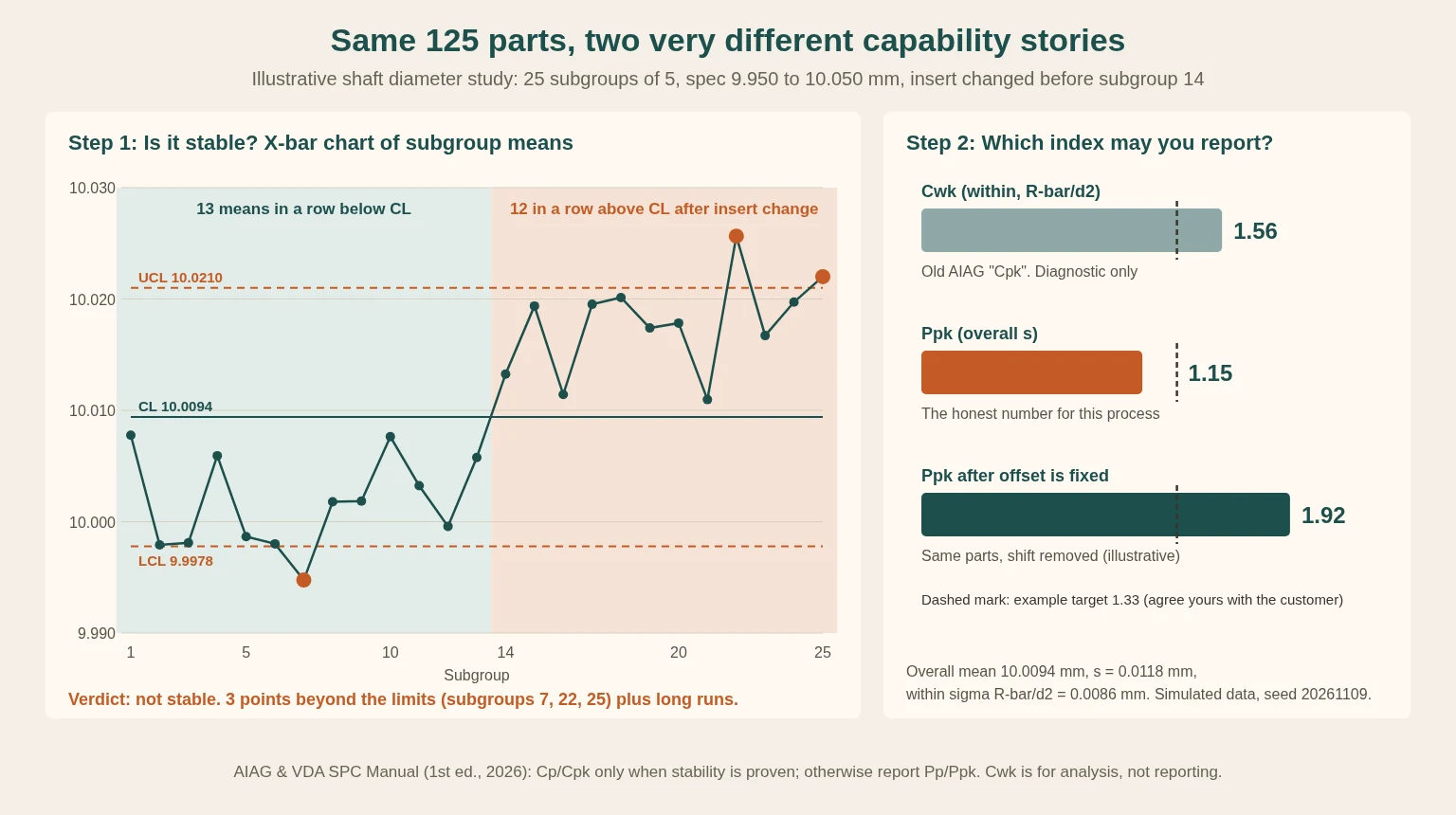
The worked example in the infographic uses simulated data (seed 20261109) for a 10.000 mm shaft with a spec of 9.950 to 10.050 mm. Within-subgroup sigma is 0.0086 mm and overall s is 0.0118 mm. The old-style index, now Cwk, is 1.56. The X-bar chart shows 13 means in a row below the center line, 12 in a row above it after the insert change, and three points beyond the limits, so the process is not stable and Cpk may not be reported at all. The honest index is Ppk 1.15, below the 1.33 example target. Correct the post-change offset and the same parts show no chart signals and a Ppk of about 1.92. The fix was a setup standard, not a better formula.
The manual also sets the study size it expects for production capability: at least 125 parts in at least 25 subgroups, taken over a period long enough for typical disturbances to show up. Its target values, such as 1.33 or 1.67 by characteristic class, are examples. The manual says the actual targets come from agreement between the organization and its customer.
Timing depends on your customers. As DQS notes, IATF 16949 sites adopt a specific SPC manual through customer-specific requirements, and DQS expects many automotive customers to allow about two years for the transition. Outside automotive, nothing forces the change, but the logic holds for any capability claim.
How to stop quoting a Borrowed Sigma
You do not need new software to start. You need to change the order of the questions. Here is a sequence that matches the 2026 manual and works for any capability study:
- Check the gauge first: The manual treats a validated measurement system as a prerequisite. If your Gage R&R eats a large share of the tolerance, every index after it is suspect. Our Gage R&R calculator and the earlier issue on getting Gage R&R right cover this step.
- Plot it in time order before you calculate anything: Build the X-bar and R chart (or the chart that fits the data; see the control chart selector) and apply your run rules. Long runs on one side of the center line are a signal even when no point is beyond the limits.
- Name the index by what you proved: Stable or controlled stable, report Cp/Cpk. Not checked, too little data, or unstable, report Pp/Ppk. Never label a within-subgroup result as Cpk on a report that leaves the building.
- Use the gap as a diagnostic: Show Cwk next to Ppk on the internal worksheet. A large gap says the problem is between subgroups: setups, insert changes, material lots, shifts, or temperature. That points the team at what changes between subgroups, not at the machine's inherent spread.
- If drift is real, model it and control it: For tool wear and similar behavior, write down the expected pattern, the adjustment limits, and who adjusts. That is what turns an unstable process into a controlled stable one you can defend.
- Re-issue the reports that matter: Pick the critical and major characteristics on your active control plans and recheck each capability claim against its control chart. Relabel or redo the ones built on a Borrowed Sigma before a customer audit finds them.
The Stat Dojo process capability lesson walks through the formulas by hand, and the process capability helper lets you test your own numbers.
Practical takeaways for this week's Gemba walk
Take one capability claim to the floor and test it:
- Ask for the chart behind the index: Pick the last capability report your team signed. Ask to see the control chart in time order for the same data. If there isn't one, the index is a Pp/Ppk at best.
- Ask the operator what moves the number: At that machine, ask: "What happens to this dimension after a tool change, a new lot, or a restart?" Compare the answer with the chart. Steps the operator knows about but the report doesn't show are between-subgroup variation.
- Find one Borrowed Sigma: On one critical characteristic, compare within-subgroup sigma with overall s. If overall s is noticeably larger, you have found your first report to relabel and your first improvement project.
Capability is a property of a stable process, not of a spreadsheet
A capability index answers one question: what will this process do from now on? It can only answer if the process is predictable. The 2026 AIAG & VDA SPC Manual makes that explicit by reserving the name Cpk for processes that have shown stability and calling everything else performance. Prove stability first, report the index you earned, and use the gap between short-term and long-term spread to find the real work.
Next Issue Preview
Next time we step off the statistics bench to another corner of the improvement toolbox, chosen from what is happening on real floors this month. Stay tuned.
Call to Action
Pull one capability report this week and put its control chart next to it. Was the process stable, and would the index survive the new naming rules? Send me the before-and-after numbers, anonymized. P.S. Share this with whoever approves PPAP or launch capability studies at your site.
Newsletter replies and questions: [email protected]
Follow updates on X.com: @kaizen6sigma
References
- AIAG & VDA, "SPC Manual: Control Loops, Performance and Capability, Control Charts," 1st edition, February 2026 (VDA QMC online document)
- AIAG, "AIAG & VDA SPC Manual, 1st Edition" (SPCAV-1)
- DQS, "Release of AIAG & VDA SPC Manual Ed 1" (July 2026)
- simpleQuE, "AIAG & VDA Release a Harmonized Statistical Process Control (SPC) Manual for Automotive Suppliers"
- NIST/SEMATECH e-Handbook of Statistical Methods, "Process Capability"