
Template Library
Lean Job Breakdown Sheet Template
A practical Excel workbook for TWI Job Instruction and Lean training systems, combining a how-to guide with a working Job Breakdown Sheet used to teach one operation clearly and consistently.
This workbook is designed as a trainer-ready Job Breakdown package. It includes a detailed guide on how to write and use a JBS, plus a working training sheet for documenting the operation header, major steps, key points, reasons, quality checks, tools, abnormality response, and trainee sign-off.
Method Preview
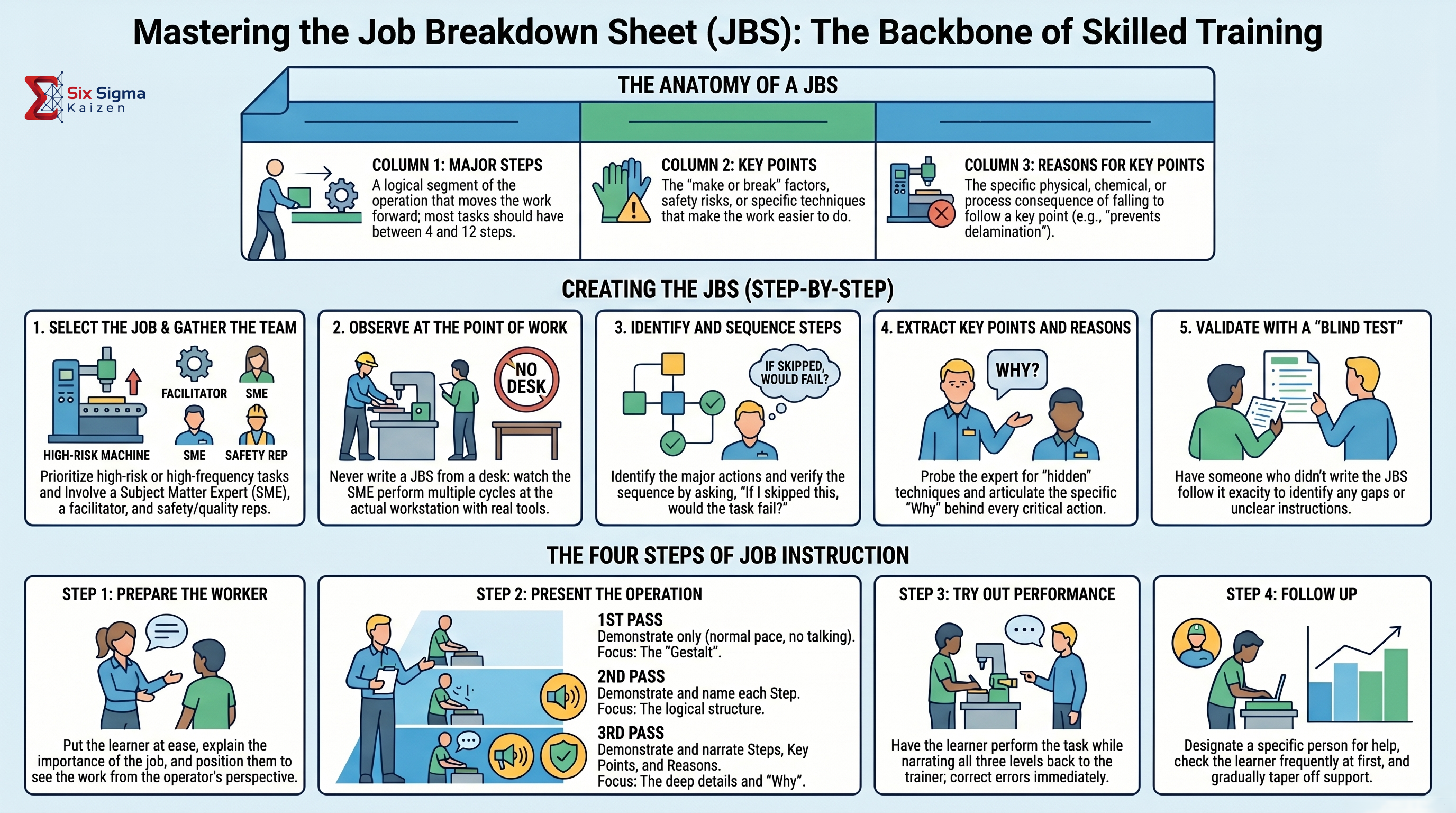
This visual shows the Job Breakdown Sheet logic the workbook is built around: major steps, key points, reasons, and the TWI Job Instruction teaching flow that makes training repeatable.
What Is Included in the Workbook
| Sheet | Purpose | What Teams Capture |
|---|---|---|
| How to Use | Method guide and trainer reference | What a JBS is, how the three columns work, step-by-step completion logic, TWI Job Instruction flow, mistakes to avoid, and document comparisons |
| Job Breakdown Sheet | Main training worksheet | Operation header, safety and purpose, major steps, key points, reasons, tools and materials, quality checks, abnormality response, notes, and trainee sign-off records |
What Makes This Template Useful
Many training documents explain only the sequence of work and ignore the deeper knowledge that makes training effective. This workbook is stronger because it reflects the TWI Job Instruction structure directly: it distinguishes what the trainer teaches, how the trainer teaches it, and why the learner should care about each point.
The first tab helps the trainer build the sheet correctly. The second tab gives a clean, structured format for the real training document. That combination matters because a JBS is easy to dilute into either an SOP or a vague checklist if the trainer is not guided well.
Key Features Inside the Template
Trainer-Focused Structure
The workbook is built for the person delivering instruction, not just the person reading a reference document. That aligns with the intended use of a true JBS.
Three-Column TWI Logic
The sheet separates major steps, key points, and reasons so the trainer can teach sequence, critical details, and consequence in one coherent flow.
Safety and Purpose Block
The template includes a clear place for PPE, safety requirements, and operation purpose so every lesson starts with operational context, not just motion.
Tools and Quality Sections
Tools, fixtures, materials, inspection points, and accept-reject criteria are captured separately so the trainer does not have to improvise those details live.
Abnormality Response Guidance
The workbook includes a specific escalation area for what the operator should stop, who they should call, and how they should respond when something goes wrong.
Training Sign-Off Record
The sign-off section supports the TWI logic of demo, perform, explain, and certification instead of treating attendance as proof of competence.
How the Workbook Is Structured
The workbook starts with a detailed explanation of the Job Breakdown Sheet itself. That tab explains what belongs in each column, how to identify key points, how to write reasons that actually matter, and how to distinguish the JBS from SOPs, work instructions, and standard work documents.
The second tab is the working sheet. It begins with the operation header, then moves into purpose and safety, the three teaching columns, tools and materials, quality checks, abnormality response, notes, and training sign-off. That gives the trainer one document that can support preparation, live demonstration, qualification, and follow-up.
Best Use Cases
- Training one repeatable operation at one workstation using TWI Job Instruction logic
- Capturing tacit expert knowledge before skilled operators leave or rotate roles
- Improving onboarding and cross-training consistency across trainers or shifts
- Supporting quality-critical and safety-critical operations where key points matter
- Building stronger internal trainer discipline in Lean or continuous-improvement environments
How to Use the Template Effectively
- Select one bounded operation rather than an entire process family.
- Observe the expert operator at the gemba instead of writing from memory or from an SOP alone.
- Break the work into major steps only after watching several real cycles.
- Probe for the key points the expert normally explains verbally but would not write automatically.
- Write reasons that tie the key points to quality, safety, efficiency, or customer consequences.
- Complete the tools, inspection, and abnormality-response sections before the training session starts.
- Use the sign-off block only after the learner has performed and explained the task, not after passive observation.
- Update the workbook whenever the method changes or a problem reveals a missing key point.
Why This Template Matters
The Job Breakdown Sheet is one of the best tools available for preserving and transferring expert operational knowledge. This workbook supports that purpose directly. It helps teams teach better, qualify more rigorously, and reduce the knowledge loss that happens when critical training details stay informal.
In practical terms, that means the file is useful anywhere the organization wants to move beyond “watch me once and try it” toward a more repeatable, trainer-led system for skill transfer.
Who Should Use This Template
- Internal trainers, supervisors, team leaders, and operations coaches teaching repeatable tasks
- Plants trying to preserve expert operator knowledge before turnover, expansion, or cross-training
- Teams building structured training around TWI Job Instruction instead of informal shadowing
Common Mistakes to Avoid
- Writing the sheet from a desk or SOP instead of observing the real job at the point of work
- Combining too many actions into one major step so the trainer cannot teach clearly
- Leaving the reason column vague, which destroys buy-in and weakens error prevention
Example Filled-Out Case
Example: A bearing press-fit operation is documented in the JBS. The trainer breaks the job into setup, alignment, press activation, verification, and unload steps, then captures the key points around orientation, force limits, gauge checks, and why each one matters for fit quality and operator safety.
Related Guides and Tools
Read the Job Breakdown Sheet Guide
Go deeper on TWI Job Instruction logic, step-point-reason writing, and trainer discipline.
Read the Train the Trainer Guide
Use the JBS inside a broader internal-trainer development system.
Read the Training Transfer Guide
Make sure the trained behavior actually sticks after the lesson ends.
Read the Standard Work Guide
Use JBS and Standard Work together when training must reflect the current best-known method.
Job Breakdown Sheet Template Frequently Asked Questions
Who should create a Job Breakdown Sheet?
The best JBS comes from collaboration between the trainer, the operator or SME, and any safety or quality support needed to capture critical details correctly.
How many major steps should a JBS usually have?
Most jobs work best with roughly four to twelve major steps. Too few hides the logic; too many turns the sheet into a confusing task transcript.
What belongs in the key points column?
Use key points for the make-or-break details tied to safety, quality, difficult technique, or details that new learners are likely to miss.
Why are reasons required in the third column?
Reasons explain the consequence behind the key point. That increases understanding and helps the learner retain the method under real working pressure.
How should the sign-off area be used?
Treat sign-off as confirmation that the learner demonstrated the job correctly, not just that training happened. It should reflect observed capability, not attendance.