
Template Library
Lean Standard Work Template
A practical Excel workbook for documenting current best-known work methods, aligning cycle time to takt time, visualizing operator movement, balancing workload, and sustaining the standard through routine audits.
This template is built as a complete Lean Standard Work package, not just a single sheet. It combines the instructional guidance, the Standard Work Combination Sheet, the workstation layout chart, a process-capacity view, a Yamazumi balancing chart, and a standardized-work audit form in one workbook.
Standard Work Preview
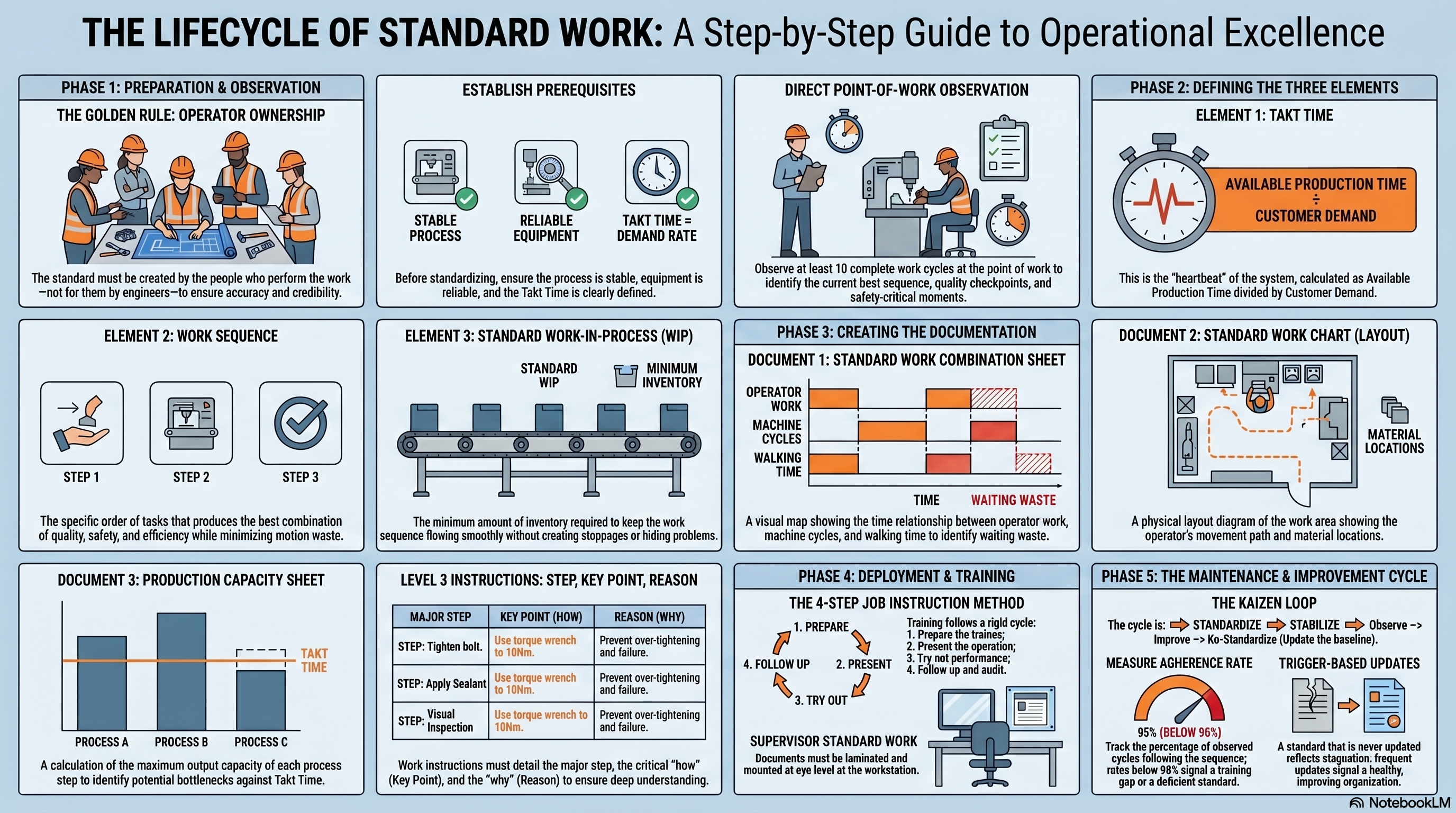
This visual summarizes the logic the workbook is built to capture: takt time, work sequence, standard work-in-process, capacity, training, and the sustainment loop that keeps the method current.
What Is Included in the Workbook
| Sheet | Purpose | What Teams Capture |
|---|---|---|
| How to Use | Method guide and reference manual | Standard Work fundamentals, takt-time logic, step-by-step workbook instructions, definitions, governance rules, and document-control guidance |
| Standard Work Combination | Main Standard Work timing document | Process header data, work-element sequence, manual time, walk time, auto or machine time, total cycle time, quality and safety checkpoints, and a visual takt-time bar layout |
| Standard Work Chart | Physical layout and operator path document | Workstation layout, movement path, SWIP locations, machine locations, quality and safety symbols, and a summarized step list for posting at the point of use |
| Process Capacity Sheet | Capacity and bottleneck analysis | Step-level manual time, walk time, machine time, changeover burden, capacity per shift, takt compliance, and constraint notes |
| Work Balancing Chart | Yamazumi balancing view | Operator assignments by element, manual or walk or auto coding, total cycle time by operator, takt comparison, and rebalance opportunities |
| SW Audit | Sustainment and adherence audit | Posting checks, revision checks, method-adherence observations, operator understanding, action items, and overall adherence scoring |
Why This Workbook Is Stronger Than a Basic Standard Work Form
Many Standard Work files stop at one page of work steps and times. That is not enough if the goal is to run a real Lean system. This workbook goes further by linking the method definition, the physical layout, the capacity check, operator balancing, and routine audit follow-through in one place.
That matters because Standard Work only works when it is tied to takt, grounded in direct observation at the gemba, and sustained through visual control and supervisory verification. A document without that structure becomes either static paperwork or an outdated training aid.
What the Workbook Teaches Teams to Do
Start With Takt and Real Observation
The how-to sheet explicitly frames Standard Work around takt time, repeatable low time, and direct gemba observation instead of estimates or memory. That is the right baseline for building a credible standard.
Separate Manual, Walk, and Machine Time
The combination sheet distinguishes operator manual work, walking, and unattended machine time so the team can see where the cycle is truly constrained and where waste exists.
Make the Physical Flow Visible
The Standard Work Chart forces the team to show the actual work area, not just a text list of steps. That exposes movement waste, poor station arrangement, SWIP location issues, and missed safety or quality touchpoints.
Verify That Capacity Can Meet Demand
The Process Capacity Sheet helps validate whether the process can actually meet takt before the standard is treated as stable. That keeps teams from documenting an impossible method as if it were acceptable.
Balance Work Across Operators
The Yamazumi sheet turns operator loading into a visible stacked-bar comparison so overburden, waiting, and uneven assignments can be corrected with intent instead of guesswork.
Sustain the Standard With Audits
The audit tab closes the loop. It checks whether the current document is posted, current, followed, understood, and improved. That is what separates active Standard Work from expired documentation.
How the Workbook Is Structured
The file follows a disciplined sequence. It starts by teaching the method, then captures the detailed work sequence and time profile, then moves into physical-layout mapping, process capacity, workload balancing, and finally audit sustainment. That flow is practical because each sheet supports a different part of the Standard Work lifecycle.
The workbook also reflects the classic Lean view that Standard Work has three core components: takt time, work sequence, and standard work-in-process. Those ideas are reinforced across the tabs instead of being buried in one isolated worksheet.
Best Use Cases
- Manual or mixed manual-machine assembly processes that need a documented current best-known method
- Cells or lines that must align operator cycle time with takt time and expose imbalance
- Workstations where movement path, SWIP, safety checks, and quality checks need to be posted visually
- Team-leader, supervisor, or industrial-engineering work focused on eliminating overburden, waiting, and bottlenecks
- Training and re-training environments where the same method must be taught consistently to new and existing operators
- Continuous-improvement efforts where process changes must be reflected in updated Standard Work and then audited
How to Use the Template Effectively
- Define the start and end of the operation clearly before documenting anything.
- Calculate takt time from available production time and customer demand first. Standard Work without takt is incomplete.
- Observe the work directly at the gemba across multiple cycles. Use repeatable low times, not estimated or self-reported values.
- Build the Process Capacity Sheet before finalizing assignments so the team sees which step is constraining throughput.
- Complete the Standard Work Combination Sheet in actual work sequence order and keep quality and safety checkpoints visible.
- Use the Standard Work Chart to show movement, machine locations, SWIP positions, and workstation relationships in the real space.
- Use the Work Balancing Chart after documenting the elements so operator loading can be redistributed against takt.
- Post the finalized documents at the workstation and use the SW Audit tab on a recurring schedule to sustain the standard.
- Update the workbook whenever the process changes. Standard Work that does not reflect the current method becomes a source of variation.
Key Lean Concepts Built Into the Workbook
| Concept | How the Workbook Uses It |
|---|---|
| Takt Time | Used as the governing pace for the combination sheet, the capacity sheet, and the balancing chart |
| Work Sequence | Captured explicitly in the combination sheet and mirrored in the posted Standard Work Chart summary |
| SWIP | Shown in the Standard Work Chart and reinforced in the audit criteria so flow is controlled, not guessed |
| Gemba Observation | The method guide requires direct observation and repeatable low-time capture before standardization |
| Yamazumi Balancing | Used to compare operator loading visually and rebalance work across the team |
| Sustainment | Handled through the Standardized Work Audit so the standard remains active and current |
Who Should Use This Template
This file is most useful for supervisors, team leaders, manufacturing engineers, industrial engineers, Lean practitioners, quality engineers, and operations managers who need to build repeatable methods into the actual production system. It is also useful for trainers because it combines the instructional reference and the operational documents in one workbook.
Why Standard Work Matters
Standard Work is one of the core conditions for stable Lean operations. Without it, process variation hides inside personal method differences, training becomes inconsistent, and improvement activity loses its baseline. With it, abnormality becomes visible, training becomes faster, and changes can be evaluated against a known starting point.
This workbook reflects that philosophy directly. It is not just a form to fill out. It is a structured system for documenting the current best-known method, testing whether it can meet demand, balancing work, and sustaining the result through audit discipline.
Common Mistakes to Avoid
- Documenting a method before the process is stable enough to standardize
- Ignoring takt time and calling any observed sequence "standard work"
- Failing to audit the document after changes so the posted standard drifts away from reality
Example Filled-Out Case
Example: A two-operator packaging cell uses the workbook to map manual work, walking, and machine time, compare the cycle to takt, rebalance the elements with a Yamazumi view, and then publish the final combination sheet and audit cadence at the workstation.
Related Guides and Tools
Read the Standard Work Guide
Use the full guide to explain takt, sequence, SWIP, auditing, and sustainment before filling out the file.
Read the Takt, Cycle, and Lead Time Guide
Tighten the timing concepts that govern whether the method can meet demand.
Use the Takt Time Optimizer
Calculate the pace the line has to run before documenting the standard method.
Use the Cycle Time vs. Takt Gap Analyzer
Check whether the observed work content can actually hit takt by station.
Standard Work Template Frequently Asked Questions
What is this standard work template designed to document?
It is designed to capture the current best method, takt relationship, work sequence, layout movement, and supporting training logic for a repeatable manufacturing task.
What is the difference between the combination sheet and the standard work chart?
The combination sheet shows operator work, machine time, walking time, and waiting. The chart shows physical motion and material layout at the workstation.
How does takt time fit into the workbook?
Takt sets the required production pace. The template helps teams compare work content and capacity to that pace so the method is practical, not just descriptive.
Who should maintain this template after launch?
The process owner should own it, but updates should be made with the operators, supervisors, and engineers who actually change or improve the method.
How should audits be connected to standard work?
Audits should confirm that the documented method is actually being followed and that drift is addressed through training, coaching, or method revision.