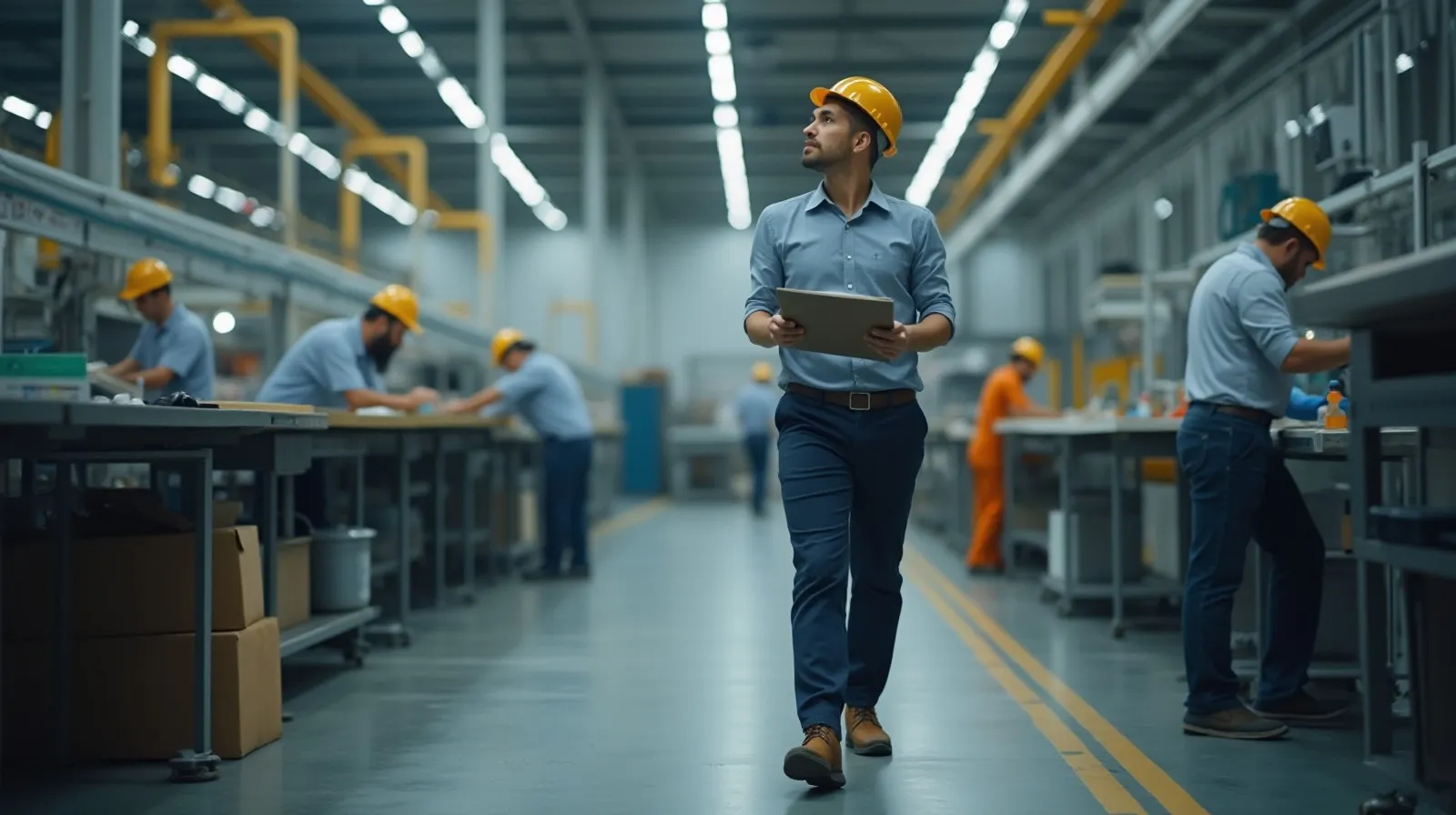
Gemba is Japanese for "the real place" — the shop floor, the warehouse aisle, the service counter, wherever the actual work happens. A Gemba walk is a structured visit to that place, made on the belief that even an experienced manager's mental model of a process drifts from reality unless it's regularly checked against direct observation. It's one of the simplest Lean practices to describe and one of the easiest to do badly, because a poorly run Gemba walk looks indistinguishable from a status-update tour or, worse, an inspection.
Taiichi Ohno, credited with popularizing the practice at Toyota, was known for having new engineers stand inside a chalk circle on the floor and simply watch a process for hours — an extreme version of the same principle: understanding a process well enough to improve it requires watching the real work, not reading a report about it.
Download the Gemba Walk Checklist Template Read the Leadership Principles Guide
Why Gemba Walks Matter
Closes the Gap Between Report and Reality
A status report reflects what someone chose to summarize; a walk shows the process as it actually runs, including what nobody thought to mention.
Surfaces Small Problems Before They Compound
A minor workaround, noticed early and understood, is far cheaper to address than the same workaround discovered after it's caused a defect or an injury.
Builds Respect for People
Asking the person doing the work to explain it, and genuinely listening, signals that their firsthand knowledge is valued — a core Lean principle, not a courtesy.
Keeps Leaders' Mental Models Current
Processes change gradually and continuously; a regular walk catches the drift before a leader's understanding is meaningfully out of date.

Core Terms
| Term | Meaning |
|---|---|
| Gemba | Japanese for "the real place" — wherever value is actually created or the work actually happens. |
| Genchi Genbutsu | "Go and see for yourself" — the broader Toyota principle a Gemba walk is one specific practice of. |
| Standard Work | The current documented best-known method for a task, which a Gemba walk checks against actual practice. |
| Muda, Mura, Muri | Waste, unevenness, and overburden — the three conditions a Gemba walk is often used to spot directly. |
| Chalk Circle | Taiichi Ohno's training practice of having an observer stand in one spot and watch a process closely for an extended period. |
| Go-and-See Cadence | The regular, repeating schedule (daily, weekly) a Gemba walk is done on, as opposed to an occasional or reactive visit. |
A Repeatable Walk Structure
| Phase | What to Do |
|---|---|
| 1. Set a Focus | Pick one process, one line, or one question to observe — a walk trying to cover everything usually covers nothing well. |
| 2. Observe Before Asking | Watch a full work cycle silently before asking any questions, so questions are grounded in what was actually seen. |
| 3. Ask Open Questions | "Walk me through what you're doing" and "what gets in your way here" surface far more than yes/no compliance checks. |
| 4. Compare to Standard | Note where actual practice differs from the documented standard, and ask why — the standard may be outdated, not the practice. |
| 5. Capture, Don't Fix on the Spot | Record observations and follow-up items; solving everything during the walk turns it into firefighting instead of observation. |
| 6. Close the Loop | Follow up on what was observed and tell the team what happened as a result — a walk with no visible follow-up quickly loses credibility. |
Walk Cadence by Role
Frequency should match how fast the role's process actually changes and how much authority the role has to act on what it sees. A shift supervisor benefits from a short daily walk; a plant manager's walk is naturally less frequent but should cover more ground.
| Role | Suggested Cadence | Typical Focus |
|---|---|---|
| Shift Supervisor | Daily, 10–15 minutes | One workstation or cell, checking against today's standard. |
| Department Manager | 2–3 times per week, 20–30 minutes | A full line or department, watching for patterns across shifts. |
| Plant Manager | Weekly, 30–45 minutes | Cross-department, tracking whether local fixes are actually sticking. |
| Executive Visit | Monthly or quarterly | Strategic alignment — does daily work reflect the direction leadership has set? |
Open Questions Worth Bringing
These work better than a compliance checklist because they invite explanation instead of a yes-or-no answer:
- "Walk me through what you're doing right now, step by step."
- "What part of this job gets in your way most often?"
- "Has anything about this process changed recently that isn't reflected in the standard?"
- "If you could fix one thing here without asking permission, what would it be?"
- "What would make it obvious, at a glance, that something's gone wrong here?"
Common Mistakes
Turning It Into an Inspection
A walk focused on catching noncompliance changes how people behave while being watched, which defeats the purpose of observing the real process.
Fixing Everything on the Spot
Solving each issue immediately turns a scheduled observation walk into ad hoc firefighting and crowds out the harder-to-see systemic problems.
Walking With an Entourage
A large group of managers following one leader intimidates the people doing the work and changes what they're willing to show or say.
Never Closing the Loop
If nothing visibly changes after repeated walks, the team reasonably concludes the walk is theater, not a genuine improvement practice.
Quick Reference
Setup Checklist
- Pick one focus area per walk.
- Set a consistent, realistic cadence rather than an occasional long walk.
- Bring open questions, not a compliance checklist.
- Plan time afterward to close the loop on what was observed.
Using the Result
- Compare observations to the documented standard, and question the standard too.
- Capture issues for follow-up rather than fixing everything immediately.
- Report back to the team on what changed as a result of the walk.
- Track whether the same issues keep recurring across walks.
Sources and Further Reading
- Masaaki Imai, Gemba Kaizen: A Commonsense Approach to a Continuous Improvement Strategy.
- Taiichi Ohno, Toyota Production System: Beyond Large-Scale Production.
- Jeffrey Liker, The Toyota Way: 14 Management Principles.
- ASQ Certified Manager of Quality/Organizational Excellence Body of Knowledge.