The Problem: Peak season starts on the most dangerous day of the job

It is mid-November. Across distribution centers, contract packers, and assembly plants, the peak-season crew is arriving: staffing-agency temps, seasonal hires, people moved over from another department. The onboarding plan in most places looks the same. A safety video in the break room, a signature on the training roster, a vest, and the instruction every supervisor has given at some point: "Just stick with Maria today. She'll show you."
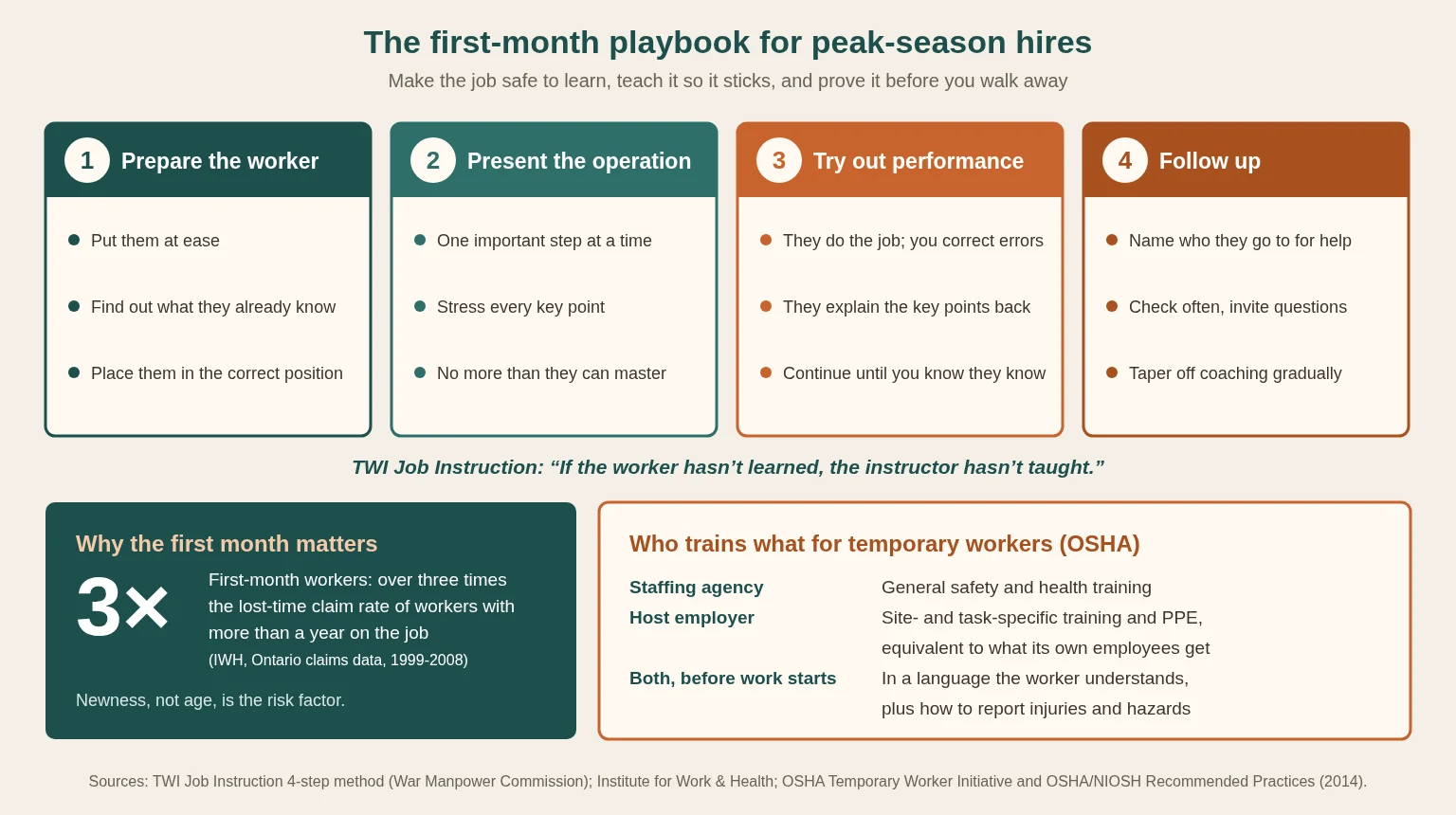
That plan meets the riskiest stretch of anyone's time on a job. Research from the Institute for Work & Health (IWH), using Ontario workers' compensation records, found that the lost-time claim rate for workers in their first month on the job stayed more than three times as high as for workers with more than a year in the job, every year from 1999 to 2008. IWH points out that the risk factor is newness, not youth: the relative risk was actually highest among workers over 45. A 2019 systematic review led by IWH scientist Curtis Breslin confirmed that the risk of acute injury is higher during the first year at a job.
The same first weeks are when new people make most of their quality mistakes: the wrong label, the skipped torque check, the carton built upside down. It is the same root cause. Nobody taught them the job in a way that stuck.
Naming the failure: the Shadow Shift
We call this the Shadow Shift. The new hire spends a day watching an experienced person work at full speed, and the organization records it as training. The experienced person is not a trained instructor, is still expected to hit rate, and skips the steps they no longer think about, which are exactly the key points a beginner needs.
This is not a new insight. The Training Within Industry (TWI) Job Instruction sessions of the 1940s opened with a demonstration designed to fail: a trainer shows a group how to tie a knot, and most of them cannot repeat it. The trainer's outline drives the lesson home: "SHOWING, alone, is NOT GOOD INSTRUCTION," and "IF THE WORKER HASN'T LEARNED, THE INSTRUCTOR HASN'T TAUGHT." A Shadow Shift is showing alone, delivered at production speed.
What good first-month training looks like
Three tools from the Lean and safety toolbox fit together here, and most sites already own all three.
- Job Instruction teaches the job so it sticks. The TWI Job Instruction method has four steps: prepare the worker, present the operation one important step at a time while stressing each key point, have them try it out and explain the key points back, then follow up with a named person to go to for help. The method is built around a job breakdown that lists important steps, key points, and the reason for each key point. Key points cover safety, quality, and the "knack" that makes the step easier. Our Lean job breakdown sheet gives you the format.
- Job hazard analysis tells you which key points are safety key points. A job hazard analysis of each peak-season task (pick faces, conveyors, box cutters, pallet jacks, ladder use, dock edges) feeds straight into the job breakdown. If the hazard and its control are not a stated key point, the trainer will not stress it. The JHA worksheet template is a fast place to start.
- Mistake-proofing removes what you cannot train fast enough. Every key point that relies on a new person remembering is a candidate for a poka-yoke: a fixture that only accepts the part one way, a color-coded tote, a guard that removes the reach-in. The mistake-proofing guide shows how to design the error out.
For temps, the legal division of labor matters too. OSHA treats the staffing agency and the host employer as joint employers, both responsible for a safe workplace. In OSHA's guidance, the agency generally provides general safety and health training, and the host employer provides site- and task-specific training and protective equipment, equivalent to what its own employees doing the same work receive. The training must be completed before the worker starts on the project and given in a language and vocabulary the worker understands, and temps must be trained on how to report injuries and hazards. OSHA's Temporary Worker Initiative bulletins cover warehousing, powered industrial trucks, lockout/tagout, and ergonomics, among others.
None of that is satisfied by a video and a signature. A roster records attendance. Only a try-out shows the person can do the job safely.
How to replace the Shadow Shift before peak hits

You do not need a new program. You need a few hours of preparation per job before the crowd arrives:
- List the jobs new people will actually do: Not job titles, tasks. Most peak crews do a short list of jobs: pick, pack, label, load, kit, inspect. Rank them by hazard and by the cost of a defect.
- Write a job breakdown for the top jobs: Important steps, key points, and reasons, on one page. Pull the safety key points from the JHA and the quality key points from your defect and complaint history. If you have standard work, build the breakdown from it.
- Poka-yoke the key points people forget: Look at last peak's incidents, near misses, and defects. Where the same key point failed more than once, change the station rather than adding a reminder.
- Train the trainers, not just the trainees: Pick the lead hands who will onboard temps and teach them the four steps. Give them protected time and a lower rate target while they instruct. A trainer chasing rate is how a Shadow Shift happens.
- Sign off on the try-out, not the attendance: Record a job as trained only when the new person has done it and explained the key points back. A skills training matrix makes this visible by person and by job, and the onboarding checklist template covers the rest of day one.
- Agree the split with the staffing agency in writing: Who delivers which training, in what language, how completion is communicated, and how temps report injuries and hazards. OSHA recommends setting out these responsibilities in the contract.
Practical takeaways for this week's Gemba walk
Take one new hire's first week to the floor and test it:
- Ask a new person to explain the key points: Find someone in their first two weeks and ask: "What's the one thing on this job that can hurt you, and what's the one thing that makes a bad part?" If they cannot answer, the instruction has not landed yet.
- Ask the trainer how they were taught to teach: If the answer is "I just show them," you have found a Shadow Shift. Ask what rate they are held to on training days.
- Trace one near miss back to day one: Pick a recent near miss or defect involving a new person and check the job breakdown. Was the failed step a stated key point? If not, add it, or mistake-proof it. The near-miss reporting guide helps you capture these before they become injuries.
Training is finished when the worker can do the job, not when the video ends
Peak season tests your onboarding, and the newest people carry the most risk. Treat their first month as a process with a defect rate, not an HR formality: break the job down, teach it in four steps, prove it with a try-out, and design out the mistakes you cannot train away in a week. The people you hire in November will tell you in December whether it worked.
Educational use only: this issue is written from a quality and operations perspective, not as legal or professional safety advice. Confirm the training and recordkeeping requirements that apply to your site with your safety professional and the applicable OSHA standards.
Next Issue Preview
Next time we pick another corner of the improvement toolbox, chosen from what is happening on real floors this month. Stay tuned.
Call to Action
Pick the one job your newest people do most this season and write its job breakdown this week: important steps, key points, and reasons, on one page. Then have someone in their first week try it out and explain it back. Send me what you changed, anonymized. P.S. Share this with whoever onboards your peak-season crew.
Newsletter replies and questions: [email protected]
Follow updates on X.com: @kaizen6sigma
References
- Institute for Work & Health, "Study finds persistence of higher injury risk for new workers"
- Morassaei S, Breslin FC, Shen M, Smith PM, "Examining job tenure and lost-time claim rates in Ontario, Canada, over a 10-year period, 1999-2008," Occupational & Environmental Medicine 70(3), 2013
- Institute for Work & Health, "Vulnerable workers and risk of work injury" (issue briefing)
- Institute for Work & Health, "Review confirms prevention system’s message about injury risks and new workers" (July 2019)
- OSHA, "Protecting Temporary Workers" (Temporary Worker Initiative)
- OSHA and NIOSH, "Recommended Practices: Protecting Temporary Workers" (OSHA 3735, 2014)
- OSHA, "Temporary Worker Initiative Bulletin: Safety and Health Training" (OSHA 3859)
- War Manpower Commission, Training Within Industry Service, "Job Instruction" sessions outline (via GovInfo)
- TWI Institute, "On-the-Job Learning: How TWI Job Instruction Removes Learning Barriers"