
The Problem: The transition plan is a redline of the manual
Over the last several issues we walked through the parts of ISO 9001:2026 that moved the most: quality culture and ethics, risks and opportunities, planning of changes, management review, continual improvement, and corrective action. This issue pulls them together into a transition plan you can actually run.
Here is the version most plants will be tempted to run. Someone in quality buys the new standard, opens the manual, and starts a redline. Clause numbers get updated. A sentence about quality culture goes into the policy. The risk procedure gets split into risks and opportunities. The certification body comes in, the documents line up, and the certificate changes from 2015 to 2026. On the floor, nothing is different.
That plan will probably pass. It also wastes the one moment in the next decade when everyone, from top management to the internal auditors, is paying attention to the quality system at the same time.
Naming the failure: Transition by Find-and-Replace
We call this Transition by Find-and-Replace. It treats the new edition as a wording change to absorb, instead of a set of questions to answer about how the operation really works.
The standard itself does not invite that reading. DNV describes the overall change as moderate, less than the move to the 2015 edition, but the changes it lists are about behavior: leaders promoting quality culture and ethical behavior in Clause 5.1.1, a clearer split between risks and opportunities in Clause 6.1, stronger requirements for managing changes in Clause 6.3, a consolidated continual improvement clause in 10.1, the 2024 climate change amendments built into Clauses 4.1 and 4.2, and a much larger Annex A of guidance. You cannot show any of those with a redline. You show them with what people do and decide.
ISO's own transition cheatsheet points the same way. Before it gets to a transition plan, it asks you to reflect on your system: has your context changed, have interested party needs changed, do your objectives need refining, are your processes interacting effectively, and are there critical information gaps. Those are floor questions, not document questions.
What the transition actually requires
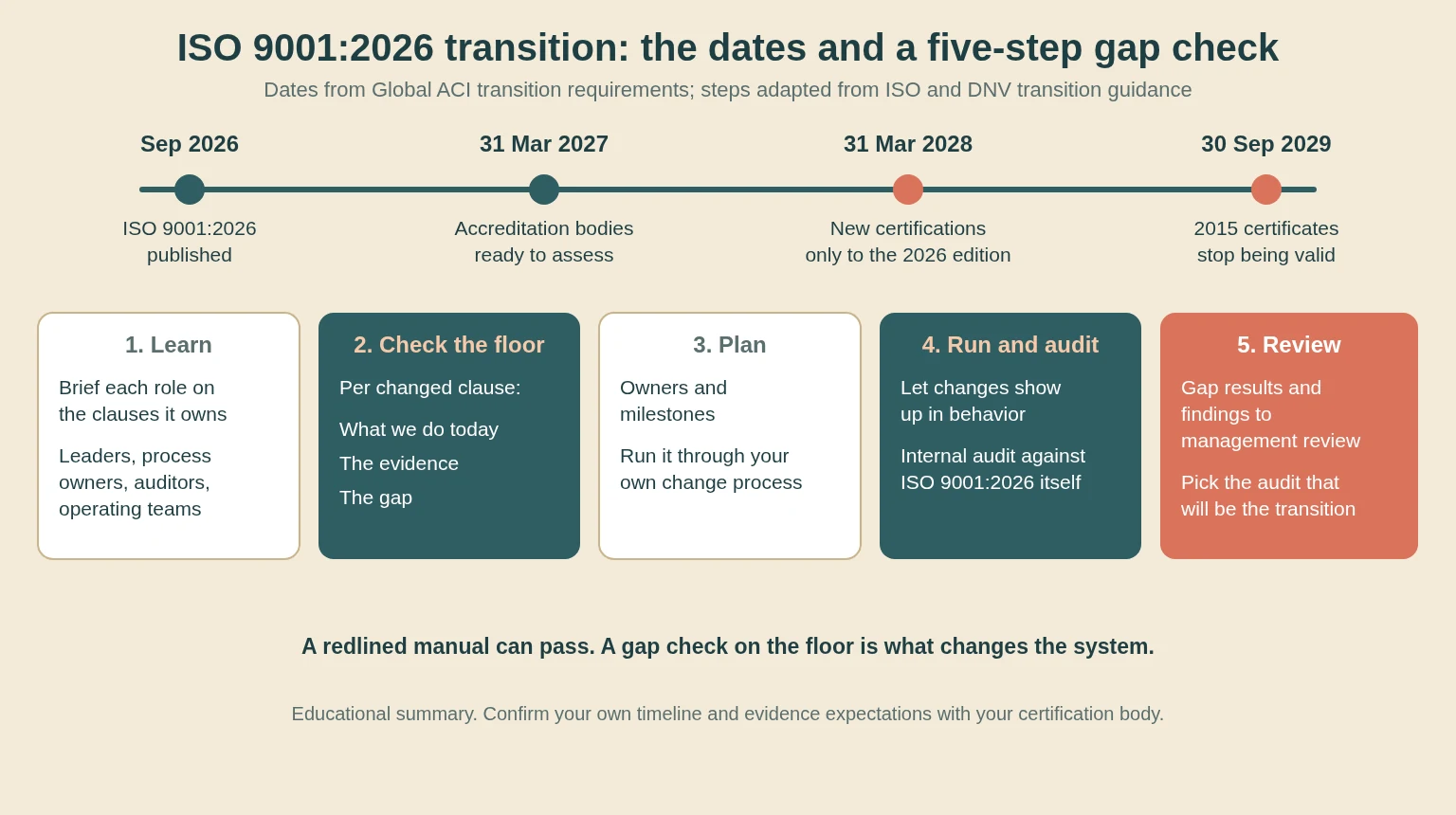
The dates are set. Global ACI, which DNV describes as the international accreditation authority, published the mandatory transition requirements, and DNV summarizes them the same way:
| Date | What happens | What it means for you |
|---|---|---|
| September 2026 | ISO publishes ISO 9001:2026, replacing ISO 9001:2015 and its 2024 climate change amendment | The clock has started. Get the standard and read it, not only the summaries. |
| By 31 March 2027 | Accreditation bodies must be ready to assess against the new edition | Ask your certification body when it expects to offer 2026 audits. |
| By 30 June 2027 and 30 September 2027 | Certification bodies submit their transition declarations; accreditation bodies make their transition decisions | Early transition audits depend on your certification body finishing this step. |
| From 31 March 2028 | New and initial accredited certifications can only be issued to ISO 9001:2026 | Any new site or business unit seeking certification goes straight to 2026. |
| 30 September 2029 | ISO 9001:2015 certificates stop being valid | Your transition audit has to be done, and the certificate issued, before this date. |
Global ACI allows the transition to happen at a scheduled surveillance or recertification audit, or at a separate transition audit. That matters for planning: pick the audit you are aiming for, then work back from it.
What will the certification body want to see? Policies differ, so ask yours. As one published example, the BVQA transition policy says that, at a minimum, the client must have completed a formal gap analysis and reviewed its output with top management at management review or an equivalent meeting, and it encourages an internal audit and management review against the new requirements before the transition audit. That is a useful bar even if your certification body sets a different one: a gap check, an internal audit, and a management review decision.
A five-step gap check you can run with your team
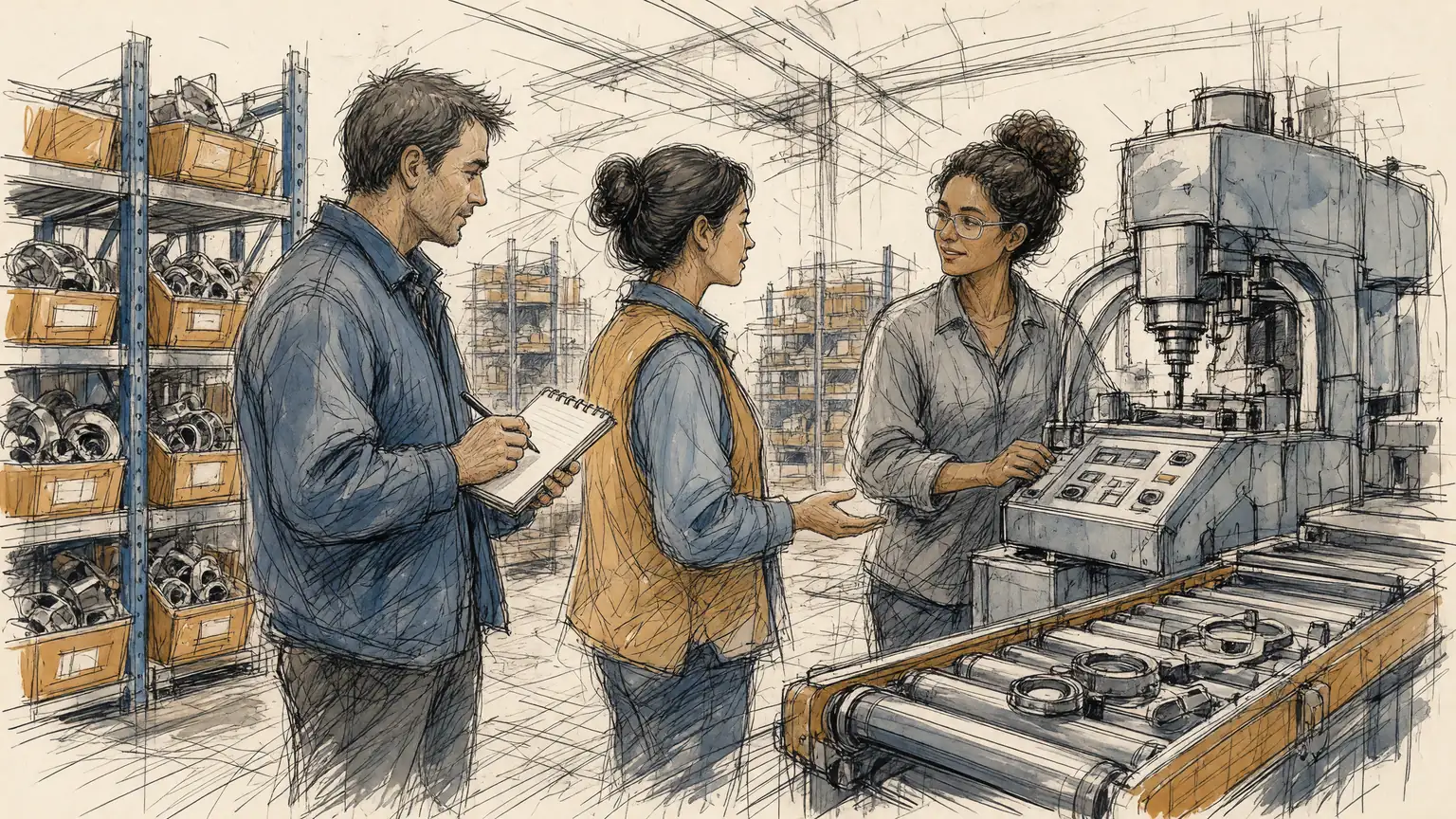
The fix for Transition by Find-and-Replace is to run the gap check where the work happens. Here is a version that fits the steps DNV and ISO recommend, with the floor questions from this series built in:
- Learn the changes, by role: ISO's cheatsheet names the people who need awareness: top management, process owners, quality professionals, internal auditors, and operational teams. They do not need the same briefing. Leaders need Clause 5.1.1 and 9.3. Process owners need 6.1 and 6.3. Internal auditors need all of it, because they will test it first.
- Check the floor, one clause at a time: For each changed clause, write three things: what we do today, the evidence that shows it, and the gap. Use the questions from earlier issues. Can operators describe what leaders do when quality and schedule conflict (quality culture)? Does the opportunity list have owners and dates (Clause 6.1)? Was the last process change checked after go-live (Clause 6.3)? Did the last management review produce decisions (Clause 9.3)? Is there one improvement pipeline (Clause 10.1)? Do corrective actions close on results (Clause 10.2)? Add Clauses 4.1 and 4.2 for climate change, which the 2026 edition now carries in the main text.
- Plan the work as a change: Turn the gaps into a short plan with owners and milestones, which is the last item on ISO's cheatsheet. Then run it through your own Clause 6.3 process. Your transition is a change to the quality system, and it is a good test of whether that process works.
- Run it, then audit it against the new edition: Give the changes time to show up in records and behavior, then have internal auditors check them against ISO 9001:2026 itself, not against your updated procedures. If the auditors only read documents, you have audited the redline.
- Review it with top management and pick the audit: Bring the gap check results, the audit findings, and the open items to management review, and record the decisions. Then agree with your certification body which audit will be the transition audit.
Two cautions from the ISO cheatsheet are worth keeping. If you run several management system standards, check that the changes stay integrated instead of creating a parallel quality-only process. If you are a small business, focus on how the changes apply to your size and activities and avoid unnecessary complexity. A twelve-person shop does not need a transition project office.
Practical takeaways for this week's Gemba walk
Take the gap check sheet to the floor before you open the manual:
- Ask one operator per area: "When quality and the schedule disagree, what happens here?" Write down the answer word for word. That is your Clause 5.1.1 baseline.
- Trace one recent change: Pick a process, equipment, or supplier change from the last quarter and walk it from the request to the station. Was the result checked after it went live?
- Find your audit date: Look up your next surveillance or recertification audit and count the months between now and then. That is the window for your gap check, internal audit, and management review.
The next challenge is auditing behavior, not paperwork
Most of the work in this plan is ordinary quality work done on purpose: walk the floor, compare what you see with what the standard asks, fix the gaps, and check that the fixes held. The step that decides whether it worked is the internal audit. If your auditors test documents, you get a 2026 manual. If they test behavior, you get a 2026 quality system. In our next discussion, we will look at how to audit the new requirements so the audit finds what is really happening.
Next Issue Preview
Next up: running your first internal audit against ISO 9001:2026. We look at audit questions for quality culture, opportunities, and planned changes that test what people do, not only what the procedure says. Stay tuned.
Call to Action
Find the date of your next certification audit. Which one is your transition audit, and is the gap check already on someone's calendar? Tell me your target date and the clause you think will be the hardest gap. P.S. Share this with whoever owns your certificate.
Newsletter replies and questions: [email protected]
Follow updates on X.com: @kaizen_6sigma
References
- DNV, "ISO 9001:2026 Standard Revision"
- Global ACI, "Global ACI Publishes Transition Requirements for ISO 9001:2026"
- Global ACI, "Transition Requirements for ISO 9001:2026" (TECH-3-TR 2029-09-30)
- ISO, "ISO 9001:2026 Transition and Readiness Cheatsheet"
- ISO/TC 176/SC 2, "ISO 9001:2026 has been released!"
- BVQA, "BVQA Transition Policy for ISO 9001:2026"